Desert locust (Schistocerca gregaria)
| Schistocerca gregaria | |
|---|---|
 | |
| Other common names | |
| Criquet pèlerin (Fr), Nzige- jangwa (Sw), Ajwal (Tamachek), jarad assahraoui (Ar) | |
| Taxonomic classification | |
| Suborder: | Caelifera |
| Family: | Acrididae |
| Subfamily: | Cyrtacanthacridinae |
| Tribe: | Cyrtacanthacridini |
| Genus: | Schistocerca |
| Scientific name | |
| Schistocerca gregaria (Forskål, 1775) | |
| Geography | |
| Native countries: | |
| Pest status | |
| Known pest | |
The desert locust Schistocerca gregaria (Forskal, 1775), distributed from Mauritania to India is considered the most dangerous of all migratory pests.[1] Because of their extraordinary traits of gregariousness, mobility, voracity, and the sheer size of their swarms, which can reach hundreds of millions of individuals in a single congregation[2], this species has plagued farmers for millennia. The desert locust is known for its highly polyphagous nature, especially during the gregarious phase.[3] This voracious species consumes not only natural vegetation but also a wide variety of food crops. When they swarm, they have the ability to decimate extensive areas of crops, leaving them completely defoliated, while their sheer weight can cause tree branches to break under their relentless onslaught.[4] Today the desert locust impacts over 60 countries. In 2019–2021 a major outbreak caused extensive damage in the Greater Horn of Africa, the Arabian Peninsula, and parts of southwest Asia.
Taxonomy
For full nomenclature and taxonomic details of this taxon, see Orthoptera Species File
Subspecies
- Schistocerca gregaria gregaria (Forskål, 1775)
- Schistocerca gregaria flaviventris (Burmeister, 1838)
Identification
The desert locust is part of the subfamily Cyrtacanthacridinae which contains many of the world’s most notorious locusts. These grasshoppers are typically large-bodied, strong fliers, and capable of forming swarms under favorable environmental conditions. Their ability to switch between solitary and gregarious phases, known as phase polyphenism,underlies their capacity for sudden population outbreaks. Important locust species include the brown locust (Locustana pardalina), the red locust (Nomadacris septemfasciata), the South American locust (Schistocerca cancellata), the Central American locust (Schistocerca piceifrons), the Bombay locust (Patanga succincta), the Sahelian tree locust (Anacridium melanorhodon), and the migratory locust (Locusta migratoria). Many of these species are adapted to arid and grassland environments across Africa, Asia, and Australia, where periodic rainfall can trigger rapid breeding and swarm development.[5]
Morphologically, Cyrtacanthacridinae species are distinguished by the presence of a prosternal spine and robust hind femora adapted for jumping. Wing coloration, often featuring bright hindwings with yellow, red, or rose tones, serves as a key diagnostic feature.

Identification details
The desert locust is a large species characterized by a straight, blunt prosternal tubercle that tilts slightly backward. Males have a bilobed subgenital plate and flat, blunt cerci. The tegmina display large, irregular spots, and the pronotum lacks a crest, appearing more constricted and saddle-shaped in the gregarious phase.[6] Desert locusts exhibit a dramatic and economically significant form of phenotypic plasticity, shifting reversibly between two distinct phases, solitary and gregarious. These phases differ greatly in appearance and physiology, but behavior plays the central role in forming and sustaining each one. Swarming starts with a complex combination between tactile, visual, chemical, and olfactory cues that drive solitary locusts, normally repelled by one another, to be attracted to each other and aggregate after only a few hours of crowding.[7][8][9][10]
Adult coloration varies by phase: solitary individuals are sandy, gray, or brownish, often with a pale median stripe on the pronotum, while gregarious individuals are pink when immature, turning dark red-brown in cool weather and bright yellow when mature (especially males). Size ranges from 60–75 mm in males and 70–90 mm in females. Gregarious nymphs are black and yellow, though heat reduces the black pattern; solitary ones are green or brown, and transitional forms show mixed colors. This is the only Old World species of its genus.[6]
S. gregaria can be confused with Anacridium m. melanorhodon , which can sometimes occur alongside desert locust populations. Anacridium can be identified by its dark antennae and a dark band at the base of the hind wings. Hoppers are easily distinguished by the distinct patterns of dark speckling on their bodies.[11]
The subspecies S. gregaria flaviventris, found in southern Africa, typically remains in the solitarious phase and rarely forms swarms, with notable exceptions occurring during limited outbreaks in 1934–1935 and 1948.[12]
Highlighted resources


Identification resources
| Title | Author(s) | Year | Geographic purview | URL |
|---|---|---|---|---|
| Michel Lecoq entomology website | Michel Lecoq | 2014 | View URL | |
| Nymphal Growth in Schistocerca | Behavioral Plasticity Research Institute | 2024 | View URL | |
| FAO locust handbook identification key | FAO Desert Locust Information Service and Food and Agriculture Organization of the United Nations | View URL | ||
| Desert locust field handbook | Centre for Agriculture and Bioscience International | 2020 | View URL | |
| Management of pest grasshoppers and locusts in Mali | Global Locust Initiative, United States Agency for International Development and Directorate of Plant Protection | 2020 | ||
| Community management of pest grasshoppers and locusts in Senegal | Global Locust Initiative, United States Agency for International Development and Directorate of Plant Protection | 2020 | ||
| Locust identification in Niger | Global Locust Initiative, United States Agency for International Development, Directorate of Plant Protection, United Nations AGRHYMET Regional Center, Le Centre National de Lutte Antiacridienne and National Network of Agriculture Chambers of Niger | 2022 | View URL | |
| CIRAD pest locust website | The French Agricultural Research Centre for International Development | View URL | ||
| FAO desert locust biology and behaviour guidelines | Food and Agriculture Organization of the United Nations | 2001 |
Distribution
The invasion area (29 million km2) of the desert locust covers all of North Africa, extending into the southern and western Iberian Peninsula, Sardinia, the Azores, Madeira, the Canary Islands, and the Cape Verde Islands. It also spans West Africa north of the equatorial rainforest, reaching eastward to northeastern Zaire and southern Tanzania along the Indian Ocean. The distribution continues across the Arabian Peninsula, Socotra, and the Middle East, extending north to eastern Turkey, Cyprus, the southern Central Asia and the Caucasus region, as well as Iran, Afghanistan, and the Indian subcontinent, reaching as far east as the Burmese border. Desert locusts have additionally been reported from the eastern Atlantic Ocean (including St. Helena), the British Isles, possibly Denmark, the Mediterranean region, the Red Sea, Gulf of Aden, Arabian Sea, Persian Gulf, Mozambique, and as far as Madagascar, Sri Lanka, and even Australia.[6] During recession periods, solitary locusts are restricted to the driest zones (16 million km2)[11]
Swarms bred during the summer often migrate from the Sahel of West Africa and Sudan to Northwest Africa, or from Sudan to the Red Sea coast. Swarms bred in the winter migrate from the Red Sea coastal plains to the interior of Saudi Arabia or Sudan. Spring-bred swarms can migrate from the interior of Arabia to Sudan and West Africa, or from the Horn of Africa to the Indo-Pakistan border.[13]
For more information and distribution records see [GBIF]
Biology and ecology
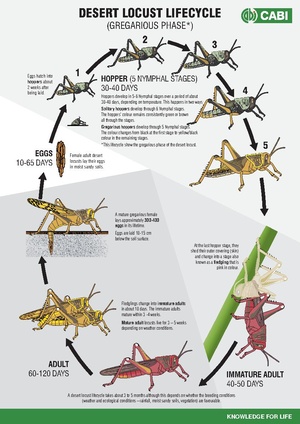
Typically, the desert locust has two to three generations occur each year, with development sometimes entering a quiescent phase in adults during drought.[11] When soil moisture is adequate, egg development in desert locusts depends on soil temperature: it stops below 15°C, shortens from about 70 days at 19°C to 10–12 days at 32–35°C, and mortality rises above 35°C. These temperature-based rates vary by region and help predict hatching. Gregarious desert locusts have five instars, while solitary females may (and less often males) undergo an extra molt following the third instar.[11] Development takes about 22 days in hot conditions (≈37°C) and over 70 days in cooler climates (≈22°C). Adult maturation time varies. In stable breeding areas, it occurs in about three weeks, but migrating mature adults only after reaching favorable sites, sometimes after several months. Under cool or dry conditions, adults may stay immature up to eight months, with maturation promoted by plant hormones and inhibited by old vegetation. Males mature first; females begin laying eggs about two days after mating.[6] The number of egg pods a female desert locust lays depends on her reproductive cycle and lifespan. In the field, the interval between layings is about ten days. Adults typically become scarce six to seven weeks after the first synchronized laying, except in cooler conditions. As a result, most females lay one pod, around 75% survive to lay a second, about 25% lay a third, and very few lay a fourth.[14] On average, females produce two egg pods each.[6] Interestingly, virgin females of this species have the ability to produce female offspring parthenogenetically.[15] Egg survival to hatching varies greatly depending on habitat conditions and the presence of predators and egg parasites. Eggs may desiccate if exposed to wind or be destroyed by prolonged flooding, though these events are uncommon. Mortality is also high when soil temperatures exceed 35°C.[14]
The maturation period of adult desert locusts varies widely. When breeding conditions remain favorable in the same area, adults may mature within about three weeks. More often, however, they migrate downwind for long distances until they find suitable conditions, delaying maturation until arrival. In some cases, adults remain immature for up to eight months if they fail to find favorable sites, especially under cool or dry conditions.[6]
Habitat and ecology
The desert locust is highly adapted to live in arid environments. Their swarms typically originate in uninhabited desert regions across North Africa, the Middle East, and Southwest Asia. During times of recession, the desert locust lives in the arid and semi-arid habitat stretching from the west coast of Africa to northwest India with an average annual rainfall of roughly 0–400 mm.[16] Rainfall plays an important role in understanding the population dynamics and behavior of the desert locust. Eggs need to absorb their weight in water from the soil during the first days of incubation to allow complete development. Desert locusts breed mainly in areas with moderate rainfall (80–400 mm), including short-grass savannahs, cultivated lands, and overgrazed long-grass savannahs south of the Sahara, East Africa, and India, with an upper rainfall limit of about 750 mm in West Africa. North of the desert belt, breeding occurs near rain-fed or irrigated croplands.[6]
Desert locust breeding follows seasonal patterns. In winter (November–December), it occurs along the Red Sea and Gulf of Aden coasts, southeastern Arabia, and the Mekran coast of Iran and Pakistan. Spring breeding (January–June) expands to western Sahara, Mauritania, Algeria, Libya, Chad, southern and eastern Arabia, Iran, Pakistan, and southern Afghanistan. Summer breeding (July–October) occurs along the southern Sahara from Mauritania to Sudan, in Ethiopia, southern Arabia, the deserts of Pakistan, and Rajasthan in northwestern India.At the end of a breeding season, adults migrate downwind at night when temperatures exceed 20°C, generally toward rainy areas where they can mature. Key complementary breeding regions include central Algeria (spring) and the southern Sahara in Mali and Niger (summer); Red Sea coasts of Sudan and Ethiopia (winter–spring) and Sudan’s interior (summer); the Red Sea coast and interior of the Arabian Peninsula (winter–summer); and the Mekran, Sind, Tharparkar, and Rajasthan deserts (winter–summer).[6]
Eggs are laid 4–15 cm deep, often in dense clusters of several hundred pods per m².[6] During recession periods, solitarious hoppers of all instars are often found together in the same area. This occurs because egg-laying is staggered and not all eggs in a single bed or pod hatch simultaneously. While hopper bands typically include a mix of instars, one or two instars are usually dominant.[14] Gregarious hoppers remain largely immobile for 2–3 days after hatching, then roost in vegetation overnight. At dawn, they move to warm themselves on the eastern side of roosts, descend to basking groups on the ground, and begin marching in a defined direction, feeding intermittently. They rest in vegetation when temperatures exceed 35°C, resuming marching in the afternoon, and return to roosts at sunset. Adults emerge nearly simultaneously within bands. After 7–10 days of cuticle hardening and flight muscle development, they fly downwind and eventually reach favorable breeding areas and mature.[6] Under warm, sunny conditions, swarms can cover up to 1000 km², rise 1000–1500 m, and travel up to 100 km per day, though some adults remain feeding beneath the swarm. Swarms can take two main forms: low-flying, flat sheets (stratiform) or towering accumulations in the air (cumuliform). Stratiform swarms are usually tens of meters deep and occur during cool, overcast weather or late afternoons. Cumuliform swarms form on hot afternoons with strong convective updrafts, especially in warmer, drier months. In these swarms, locusts within the lowest 400 m often move in streams in varying directions, some rejoining the main swarm, while locusts at higher levels may form randomly oriented streams or swirling sheets.[14]
Outbreak areas arise as a result of rainfall events, subsequent vegetation, and temperature. After a substantial rainfall event somewhere in the recession zone, locusts seize the opportunity and multiply rapidly. Under ideal conditions, locusts can increase 16-20 times every three months after a new generation of breeding. Gregarization can occur as large numbers of locusts concentrate on patches of green vegetation (intensified as moisture drys and vegetation becomes sparse) increasing physical contact and initiating hopper bands or adult swarms that behave as a cohesive unit. If more rains come, populations can explode, producing two or more successive generations.[13]

Desert locusts are highly mobile, migrating hundreds of kilometers in response to seasonal rains. Swarms migrate seasonally across Africa, the Middle East, and South Asia, with routes shifting by year. From September to November, swarms move from Sudan and northern Ethiopia into East Africa, the Arabian Peninsula, and northwest Africa, reaching as far as Morocco and Mauritania. Some travel south of the Sahara before returning east to Sudan by spring, while others move from India and Pakistan into Iran and the eastern Arabian Penninsula. Between February and April, migrations occur from East Africa into Ethiopia, Somalia, and Sudan, and from Arabia into the Middle East, Iran, and Pakistan. From May to July, swarms spread from the Middle East and northern Arabia into North and West Africa, and eastward into Pakistan and India. Additional movements include southward shifts across the Sahara into the Sahel, and smaller or rarer migrations along the Red Sea coast, across Arabia, and from northwest India into southern Asia.[6] Swarms usually migrate during the day, while solitary locusts may also fly at night.[11]
Desert locust hoppers can eat their body weight daily, starting at 20 mg in the first instar to around 1.5 g in the middle of the fifth instar.[6] Migrating immature adults need to eat 2-3 g per day and up to three times as much. Although mature adult consumption declines (less in females), a swarm often has 50 million individuals per square kilometer, translating to a moderate swarm of 10 km2 would eat ~1000 tonnes of vegetation daily on migration.[6]
Many natural enemies attack desert locusts, but climate remains the main regulating factor. Protozoans, fungi, and nematodes sometimes cause high mortality under humid conditions but are unreliable for control. Egg predators and parasites, such as Scelio sudanensis, Systoechus somali, Stomorhina lunata, and various beetles, can destroy much of an egg field. Hoppers are parasitized by flies like Symmictus costatus and Blaesoxipha filipjevi, and also preyed on by ants, wasps, spiders, reptiles, and birds. While birds and other predators may limit small populations, they have little effect on large swarms.[6]
Land-use / climate change
Warming oceans and increased temperatures are predicted to bring more intense rainfall, stronger winds, and tropical cyclones to areas like the North Indian Ocean which may create a favorable habitat for desert locust breeding and migration.[17][18] Temperature, moisture, and light jointly influence desert locust egg hatching, development, and reproduction.[19] Optimal temperatures accelerate development and support large population surges. Historical outbreaks show a link between seasonal temperature shifts and locust plagues.[20] Projected increases in rainfall, soil moisture, and temperature are expected to expand the locust’s range and breeding potential.[21][20] Read more about climate change and locusts here.
The anticipated responses of the solitarious ranges of the two desert locust subspecies are expected to differ.[4] The widely recognized northern subspecies (S. gregaria) may experience contraction in certain regions[22], whereas the less investigated southern subspecies (S. gregaria flaviventris) is projected to undergo expansion.[23] This study underscores that although S. g. flaviventris has infrequently experienced outbreaks in the past, it represents a subspecies that could potentially pose a future threat.[4]
Field studies indicate that camel grazing may promote gregarization by forcing locusts to concentrate on remaining ungrazed vegetation.[24] In agricultural regions, S. gregaria is generally more abundant in cultivated fields than in grazing areas.[25] When present in grazing zones, desert locusts often feed on trees and shrubs,[26] reducing direct competition with livestock. This preference may be linked to plant nitrogen content, as S. gregaria grows faster, survives better, and is more numerous in areas with nitrogen-rich or fertilized plants and lower grazing pressure.[27][16]
Pest status
For millennia, humans have feared desert locusts for their ability to devastate crops, with the first records appearing on Egyptian tombs in 2420 BC.[28] The desert locust is likely the oldest and most destructive migratory pest in the world.[1] Its plagues result from extreme gregariousness, high mobility, voracious feeding, and enormous swarm sizes, sometimes reaching hundreds of millions of individuals, capable of stripping crops completely and even breaking tree branches under their weight. Some invasion cycles have lasted over 20 years. Although chemical pesticides, improved transportation and infrastructure, and advances in communications, remote sensing, and early warning have reduced the frequency and duration of plagues, desert locusts remain a major threat to agriculture and long-term food security. They exacerbate poverty and the vulnerability of already precarious households and, while not the sole cause of famines, can be an important contributing factor.[11][29][13]
Desert locusts are highly polyphagous, particularly in their gregarious phase. They consume both natural vegetation and a wide variety of crops, including banana, barley, citrus, cotton, date palm, grape, maize, millet, vegetables, rice, sorghum, sugarcane, and wheat. When preferred plants are unavailable, they may also feed on less common hosts such as lentil, potato, sunflower, tobacco, and wax myrtle. They cause additional damage by cutting stems and leaves they do not consume and breaking branches under their weight when densely settled. Because swarms are highly mobile, the extent of damage varies greatly by season and region. The most severe crop losses occur when young, migrating swarms of immature adults invade cultivated areas.[11][6]
Management
Responsibility for desert locust forecasting and control coordination shifted from the United Kingdom to The Food and Agriculture Organization of the United Nations (FAO) in the 1950s. In 1955, the FAO established the Desert Locust Control Committee (DLCC), based in Rome, as the global coordinating body for early warning, prevention, and management of desert locusts. The DLCC serves as the main forum for locust-affected countries, donors, and partner agencies. It provides global guidance on early warning, control, and emergency response, and oversees three regional commissions, the Commission for Controlling the Desert Locust in the Central Region (CRC), the Commission for Controlling the Desert Locust in South-West Asia (SWAC), and the Commission for Controlling the Desert Locust in the Western Region (CLCPRO), along with the Desert Locust Control Organization for Eastern Africa (DLCO-EA). Together, these bodies promote preventive control through national units, capacity building, and coordination in survey, control, training, and safety. The DLCC currently includes 64 member states and operates in Arabic, English, and French.[4]
The FAO Desert Locust Information Service (DLIS) serves as the central hub for all data and analysis needed to support the desert locust early warning system. It produces monthly situation reports and forecasts for affected countries and issues warnings about potential invasions or major developments.[30] For a full history and more details on the DLIS please visit the Locust Watch website.
Each affected country from Mauritania to India has a National Locust Control Unit responsible for monitoring and early intervention. Surveys focus on areas with known outbreak potential, expected seasonal activity, and recent rainfall or vegetation growth identified through meteorological or satellite data. Using local knowledge of terrain and vegetation, often concentrated in patches or along wadis, teams efficiently target high-risk zones through a layered, stepwise monitoring approach. To prevent plagues from developing and spreading, affected countries in Africa and Asia use an early warning and preventive control strategy, the most effective and economical approach. This system relies on monitoring environmental conditions and locust populations in outbreak areas, enabling rapid intervention against the first gregarious populations while they are still small and localized. Once a plague develops, control efforts become less effective and mostly temporary.[11]
Currently, desert locust control primarily relies on insecticides applied in small, concentrated doses using vehicle-mounted or aerial sprayers at ultra-low volume (ULV). This approach allows efficient treatment of vast and remote areas without requiring water. In addition to large-scale blanket applications, certain insecticides are also effective when used as “barrier treatments” targeting hopper bands. Commonly recommended insecticides include bendiocarb, chlorpyrifos, deltamethrin, diflubenzuron, fenitrothion, fipronil, lambda-cyhalothrin, malathion, teflubenzuron, and triflumuron.[11]
Metarhizium acridum is effective against S. gregaria[31][32] and was successfully used in Somalia during the 2019-2021 outbreak in a widespread campaign of over 100,000 ha.[4]
Outbreaks

Historical data indicate that desert locust plagues occurred in four out of every five years from 1860 until the end of the 1949–1963 plague, after which periods of recessions became more common.[33] Five major plagues occurred in the first 60 years of the twentieth century, lasting as long as fourteen years.[13] 1861–67, 1869–81, 1889–1910, 1912–19, 1926–34, 1940–48, 1949–63, 1967–1968, 1978.[6] and 1986–1989[34]. The three plagues in this time frame affected nearly all countries within the invasion area, with swarms reported in southwest Arabia in 46 of the 53 years between 1926 and 1979. Plagues typically lasted 7–22 years and were followed by recessions of 1–7 years, with no consistent pattern or periodicity in their occurrence. Although individual regions may be affected at different times, swarm movement ensures that no area remains uninfested during major plague periods.[6]
Upsurges in 1972–1974, 1987–1989, 1992–1994, 1994–1996, 1996–1998, 2004–2005, and 2019–2021
Outbreaks 2006, 2007, 2008, 2009, 2012, 2013, 2014, 2016, 2018.
2003–2005 Plague
In 2003–2004, swarms of desert locusts caused the worst outbreak in Africa since 1987–1989, affecting eleven West African countries and disrupting agriculture in food-insecure regions.[35] During July to September 2003, unusually heavy rains in the Sahel triggered a major desert locust outbreak across West Africa. Swarms matured and bred in Mali and Niger, then migrated to Northwest Africa for a second breeding cycle between December 2003 and March 2004. Summer rains in the Sahel provided ideal conditions for survival and reproduction, allowing swarms to lay eggs in Senegal, Mauritania, Mali, and Niger. The 2003–2004 outbreak was the worst in the region since 1987–1989, with international response costs around $300 million. At its peak, 3.5 million hectares of crop and pastureland were at risk, with nearly two million hectares treated with pesticides.[36] Although FAO’s early warning systems detected the threat early and alerted donors, the international response was delayed, allowing locust populations to expand rapidly. This event highlighted the need for integrating seasonal rainfall forecasts into early warning systems to predict locust risks earlier, giving affected countries and donors more time to plan and fund control operations.[35] Control cost totaled over $500 million USD [37] and there were 80–100% crop losses in regions like Sub-Saharan Africa.[2]

2019–2021 upsurge
For some countries in the Greater Horn of Africa, the Arabian Peninsula, and parts of southwest Asia, the 2019-2021 desert locust upsurge was the worst seen in seventy years, affecting 2.5 million people in 2020 and at least another 1 million in early 2021.[38] The situation spread to eight African countries, Djibouti, Eritrea, Ethiopia, Kenya, Somalia, South Sudan, Uganda, and Tanzania. India and Pakistan were impacted as well as the Middle Eastern countries of Omen, Yemen, Saudi Arabia, Iraq, Kuwait, Bahrain, and Qatar.[39]
Click here for a full page on this outbreak
Two cyclones in 2018, May Cyclone Mekunu and October Cyclone Luban brought heavy rains to the Empty Quarter on the Arabian Peninsula. These unusually conducive weather conditions allowed at least three generations of locust breeding that went undetected and developed into the 2019-2021 upsurge. Swarms moved into Saudi Arabia, southern Iran, and southwest to the interior of Yemen from January to March 2019. In June, two generations of spring breeding spread to the Horn of Africa and to the Indo-Pakistan border. Heavy monsoon rains encouraged three more generations in the Indo-Pakistan area while two generations proliferated in the northern Horn of Africa. At the end of 2019, Cyclone Pawan in northeast Somalia brought rain to sustain two more generations of breeding that moved into Kenya.[39]
In 2020, locusts spread within the Horn of Africa and into East Africa, reaching southern Kenya and northern Tanzania, northeast Uganda, southeast South Sudan, and northeast D.R. Congo. Kenya, Ethiopia, and Somalia were the most severely impacted. Aerial and ground control operations continued against widespread swarm laying, hatchlings, and numerous hopper bands throughout northern and central Kenya and southern Ethiopia.[39]
New swarms formed in northern Somalia and Kenya. Several swarms were present in Yemen and some moved into Saudi Arabia. In February 2020, swarms appeared in Iraq, Kuwait, Bahrain, and Qatar, the United Arab Emirates and 22 swarms arrived in southern Iran, where locusts quickly matured and laid eggs. Residual summer-bred swarms were present in Rajasthan, India, and laid eggs in areas of Punjab, Pakistan.[39]
2021
During the dry season in East Africa, desert locust swarms remained immature for several months longer than usual. Infestations declined by mid-March due to control operations, the absence of rains and further maturing in Ethiopia and Kenya. The same swarm was reported six times in Kenya, giving the false impression of greater swarm activity. However, new immature swarms were forming in NW and NE Somalia and persisted for several months until sufficient rain came in later April allowing maturation. [40] Mature swarms moved north into eastern Ethiopia and adjacent areas of NW Somalia. There was widespread hatching and bands in Saudi Arabia's interior. Mature adult groups of locusts and small swarms rode a strong southerly wind from Saudi Arabia to Iraq, Jordan, Syria, Lebanon, Israel, and Egypt. [41] By June 2021, there was an increasing number of immature swarms mostly in NW Somalia but also eastern Ethiopia, SE Djibouti. Breeding ceaseed in N Saudi Arabia and immature groups move south. [42] Conflict in Ethiopia prevented management operations and by October a few small mature groups and swarms from N Ethiopia move to Eritrea coast and lay eggs.[43] Control activities continued in NE Somalia and a few small spring-bred swarms from NE Somalia arrived on the Ethiopia/Kenya border. By December, few swarms remained and poor winter breeding along the Red Sea helped the situation calm down.[43] The upsurge in the Horn of Africa was officially declared over in February 2022 and officially on March 2, 2022 in the Desert Locust Bulletin.
The FAO and its partners raised more than 243 million USD to mobilize control efforts, from surveillance to rapid support for countries scrambling to put together response systems.[44] Aerial operations treated desert locusts across 2.3 million ha in the Horn of Africa and Yemen since January 2020. FAO reports these efforts averted 4.5 million metric tonnes of crop losses, saved 900 million liters of milk production, and secured food for nearly 42 million people.[45] The commercial value of the cereal and milk loss averted is estimated at USD 1.8 billion.[45] However, the complex interplay of tradeoffs that accompany the widespread use of organophosphates and pyrethroid pesticides is understudied and could be felt for years to come. Among the affected countries, Somalia was alone in exclusively using biopesticides and insect growth regulators (IGRs), which are slower-acting and much less harmful to non-target organisms and human health than synthetic pesticides.[46] See biopesticides page.
FAO Locust Watch has current situation bulletins and a timeline of the 2019-2021 outbreak.
Outbreak media coverage 2020–2021


Associated organizations
| Organization name | Acronym | Website | Type | Focus | Focus keywords | Geographic purview |
|---|---|---|---|---|---|---|
| Behavioral Plasticity Research Institute | BPRI | View | Other | Research, Education | Phenotypic plasticity, Phase polyphenism | United States, Mexico |
| Commission for Controlling the Desert Locust in the Central Region | CRC | View | Intergovernmental Organization | Management, Governance, Education, Information Hub | Training, Regional cooperation, Monitoring, Control, Forecasting, Natural sciences | Bahrain, Djibouti, Egypt, Eritrea, Ethiopia, Jordan, Kuwait, Iraq, Lebanon, Oman, Qatar, Saudi Arabia, Sudan, Syria, United Arab Emirates, Yemen, Somalia |
| Desert Locust Control Organization for Eastern Africa | DLCO EA | View | Intergovernmental Organization | Education, Governance, Management, Research | Training, Regional cooperation, Monitoring, Control, Coordination | Djibouti, Eritrea, Ethiopia, Kenya, Somalia, South Sudan, Sudan, Uganda, Tanzania |
| FAO Commission for Controlling the Desert Locust in Northwest Africa | CLCPANO | View | Intergovernmental Organization | Governance, Education, Management, Research | Training, Regional cooperation, Monitoring, Control, Natural sciences | Algeria, Libya, Morocco, Tunisia, Mauritania |
| FAO Commission for Controlling the Desert Locust in South-West Asia | SWAC | View | Intergovernmental Organization | Information Hub, Education, Governance | Training, Monitoring, Control, Regional cooperation, Natural sciences | India, Pakistan, Afghanistan, Iran |
| FAO Commission for Controlling the Desert Locust in the Western Region | CLCPRO | View | Intergovernmental Organization | Governance, Research, Management | Training, Regional cooperation, Monitoring, Control, Natural sciences | Burkina Faso, Libya, Mali, Morocco, Mauritania, Niger |
| FAO Desert Locust Control Committee | DLCC | View | Intergovernmental Organization | Development, Management, Governance | Agricultural development, Community development, Control, International development, Regional cooperation, Sustainable development, Training, Natural sciences | Afghanistan, Algeria, Burkina Faso, Cameroon, Cape Verde, Central African Republic, Chad, Ivory Coast, Djibouti, Egypt, Eritrea, Ethiopia, Gambia, Ghana, Guinea, India, Iran, Iraq, Israel, Jordan, Kenya, Kuwait, Lebanon, Libya, Mali, Mauritania, Morocco, Netherlands, Niger, Oman, Pakistan, Portugal, Qatar, Saudi Arabia, Senegal, Sierra Leone, Somalia, Spain, Sudan, Syria, Tanzania, Togo, Tunisia, Uganda, [[United Arab Em... |
| FAO Desert Locust Information Service | DLIS | View | Intergovernmental Organization | Development, Management, Education, Governance, Information Hub, Funding | Agricultural development, Community development, Control, Coordination, Emergency assistance, Forecasting, International development, Media, Monitoring, Policy, Regional cooperation, Sustainable development, Technology, Training, Early warning, Natural sciences | Africa, Asia, Europe |
| FAO Emergency Prevention System for Transboundary Animal and Plant Pests and Diseases | EMPRES | View | Intergovernmental Organization | Management, Governance, Research | Monitoring, Control, Training, Regional cooperation, Natural sciences | Africa, Americas, Asia, Europe |
| FAO Locusts and Transboundary Plant Pests and Diseases | NSPMD | View | Intergovernmental Organization | Development | Agricultural development, Community development | Africa, Americas, Asia, Europe |
| Global Locust Initiative | GLI | View | University | Research, Education, Information Hub | Sustainable development, Ecology, Nutrition, Social science, Natural sciences, Agriculture, Agroecology, Biology, Behavior, Biological control, Climate change, Education, Sustainability science, Geometric framework, Grazing, Governance, Food security, Arts and humanities, Land use management, Landscape ecology, Locusts, Migration, Phase polyphenism, Phenotypic plasticity, Soil science | United States, Senegal, Australia, China, Argentina, Bolivia, Paraguay, Uruguay, Mali |
| IGAD Climate Prediction and Applications Centre | ICPAC | View | Intergovernmental Organization | Development, Management, Research | Forecasting, Agricultural development, International development, Early warning, Natural sciences | Kenya |
| India Locust Warning Organization | LWO | Government | Management, Information Hub, Research | Monitoring, Control, Forecasting, Training, Natural sciences | India | |
| Intergovernmental Authority on Development | IGAD | View | Intergovernmental Organization | Development, Management, Research | Forecasting, Agricultural development, International development, Natural sciences | Djibouti, Ethiopia, Kenya, Somalia, South Sudan, Sudan, Uganda |
| International Centre of Insect Physiology and Ecology | ICIPE | View | Non-profit Organization | Research, Education | Sustainable development, Training, Natural sciences | Kenya |
| International Red Locust Control Organization for Central and Southern Africa | IRLCO CSA | [www.redlocust.org.zm/ View] | Intergovernmental Organization | Management, Governance, Funding | Monitoring, Control, Regional cooperation, Forecasting, Natural sciences | Zambia, Zimbabwe, Mozambique, Kenya, Tanzania, Malawi |
| Le Centre National de Lutte Antiacridienne | CNLA | View | Government | Research, Management, Governance | Monitoring, Control, Coordination, Forecasting, Natural sciences | Mauritania |
| Ministry of Agriculture Sudan | View | Government | Agricultural development | Sudan | ||
| Ministry of Agriculture, Animal Industry and Fisheries of the Republic of Uganda | View | Government | Governance, Management | Management | Uganda | |
| Ministry of Agriculture, Fisheries and Water Resources of Oman | View | Government | Management | Survey, Monitoring, Management, Control | Oman | |
| Ministry of Agriculture, Water, Fishery, Livestock and Marine Resources | MAEPE-RH | View | Government | Governance, Management | Management, Forecasting, Monitoring, Control | Djibouti |
| National Desert Locust Control Center | CNLCP | View | Government | Research, Management, Development, Governance | Coordination, Monitoring, Control, Agricultural development, Forecasting, Policy, Regional cooperation, Sustainable development, Technology, Training | Mali |
| Plant Protection, Quarantine and Storage, and the Regional Locust cum Integrated Pest Management Center | RLCIPMC | View | Government | Management | plant protection, Management | India |
| Sahel Institute | INSAH | View | Intergovernmental Organization, University | Development, Governance, Research, Management, Information Hub | Agricultural development, Coordination, International development, Policy, Regional cooperation, Training, Natural sciences | Benin, Ivory Coast, Gambia, Guinea, Guinea-Bissau, Mauritania, Senegal, Togo, Burkina Faso, Mali, Niger, Chad, Cape Verde |
| The French Agricultural Research Centre for International Development | CIRAD | View | Government | Education, Development, Research, Management | Forecasting, International development, Training, Agricultural development, Sustainable development, Natural sciences, Modeling, Monitoring, Research, Control, Community development | France |
| United Nations AGRHYMET Regional Center | AGRHYMET | View | Other | Development, Education | Training, International development | Niger |
Resources
| Title | Author(s) | Year | Geographic purview | URL |
|---|---|---|---|---|
| FAO Desert Locust Bulletin Archives | FAO Desert Locust Information Service and Food and Agriculture Organization of the United Nations | |||
| Locust outbreak media coverage in Ethiopia | France 24 | 2020 | View URL | |
| NOAA HYSPLIT Desert Locust Trajectory Model | National Oceanic and Atmospheric Administration | 2020 | ||
| Environmental side-effects of locust and grasshopper control | Food and Agriculture Organization of the United Nations,Wim C. Mullié | 1990s | ||
| Rearing and Breeding Locusts in the Laboratory | Anti-Locust Research Centre,Philip Hunter-Jones | 1966 | View URL | |
| ARC-PHP Southern African desert locust fact sheet series | Agricultural Research Council of South Africa,Roger Price | 2024 | View URL | |
| FAO Desert Locust Bulletin | FAO Desert Locust Information Service and Food and Agriculture Organization of the United Nations | |||
| Weather and Desert Locusts | Food and Agriculture Organization of the United Nations | 2016 | View URL | |
| Commission for Controlling the Desert Locust in the Central Region (CRC) locust management materials | Commission for Controlling the Desert Locust in the Central Region and Food and Agriculture Organization of the United Nations | |||
| Standard Operating Procedures (SOP) for Desert Locust Control | Commission for Controlling the Desert Locust in the Central Region and Food and Agriculture Organization of the United Nations | |||
| Resources for an outbreak campaign | View URL | |||
| Desert locust lifecycle poster | Centre for Agriculture and Bioscience International | View URL | ||
| FAO Commission for Controlling the Desert Locust in the Western Region (CLCPRO) national management plans | Food and Agriculture Organization of the United Nations and FAO Commission for Controlling the Desert Locust in the Western Region | |||
| FAO Commission for Controlling the Desert Locust in the Western Region (CLCPRO) Report of Joint Prospecting with the Use of Drones or Biopesticides in Desert Locust Surveillance | Food and Agriculture Organization of the United Nations and FAO Commission for Controlling the Desert Locust in the Western Region | |||
| FAO Commission for Controlling the Desert Locust in the Western Region (CLCPRO) workshops | Food and Agriculture Organization of the United Nations and FAO Commission for Controlling the Desert Locust in the Western Region | |||
| FAO Commission for Controlling the Desert Locust in the Western Region (CLCPRO) commission meeting reports | Food and Agriculture Organization of the United Nations and FAO Commission for Controlling the Desert Locust in the Western Region | |||
| Commission for Controlling the Desert Locust in the Central Region (CRC) training and workshops | Commission for Controlling the Desert Locust in the Central Region and Food and Agriculture Organization of the United Nations | 1971 | ||
| Commission for Controlling the Desert Locust in the Central Region (CRC) survey reports | Commission for Controlling the Desert Locust in the Central Region and Food and Agriculture Organization of the United Nations | 1971 | ||
| Commission for Controlling the Desert Locust in the Central Region (CRC) committee meetings | Commission for Controlling the Desert Locust in the Central Region and Food and Agriculture Organization of the United Nations | 1971 | ||
| The desert locust guidelines biology and behavior | Food and Agriculture Organization of the United Nations | 1994 | View URL | |
| Estimate the potential impact of DL resources control an outbreak campaign excel file worksheets | Commission for Controlling the Desert Locust in the Central Region and Food and Agriculture Organization of the United Nations | |||
| Commission for Controlling the Desert Locust in the Central Region (CRC) ad hoc, emergency, other meetings | Commission for Controlling the Desert Locust in the Central Region and Food and Agriculture Organization of the United Nations | 1971 | ||
| EMPRES meeting, research, workshop, survey report collection | Commission for Controlling the Desert Locust in the Central Region, Food and Agriculture Organization of the United Nations and FAO Emergency Prevention System for Transboundary Animal and Plant Pests and Diseases | 2002 | ||
| World Bank Procurement plan for Ethiopia 2020 2021 | 2012 | View URL | ||
| Michel Lecoq entomology website | Michel Lecoq | 2014 | View URL | |
| East Africa regional desert locust impact monitoring reports | The Food Security and Nutrition Working Group | 2021 | ||
| Behind the success of desert locust control | 2022 | View URL | ||
| Atlas of desert locust breeding habitats | Food and Agriculture Organization of the United Nations,George Basil Popov,G.B. Popov | 1997 | ||
| Liste globale des pesticides autorisés par le Comité Sahélien des Pesticides | Permanent Interstates Committee for Drought Control in the Sahel | 2020 | View URL | |
| Desert locust upsurge progress report on the response in the Greater Horn of Africa and Yemen | Commission for Controlling the Desert Locust in the Central Region and Food and Agriculture Organization of the United Nations | 2020 | View URL | |
| Guide for identifying desert locust | Commission for Controlling the Desert Locust in the Central Region and Food and Agriculture Organization of the United Nations | View URL | ||
| Locust Invasion in Ethiopia | Sydney Gourlay and John Ilukor | 2021 | View URL | |
| Field efficacy trials with the entomopathogen Metarhizium anisopliae var. acridum (Green Muscle) against the desert locust (Schistocerca gregaria) and monitoring of it's operational use | Commission for Controlling the Desert Locust in the Central Region and Food and Agriculture Organization of the United Nations | 2007 | View URL | |
| Guidelines for developing research proposals | Commission for Controlling the Desert Locust in the Central Region and Food and Agriculture Organization of the United Nations | View URL | ||
| 2020 Appeal to the international community | Food and Agriculture Organization of the United Nations and Ministry of Agriculture, Water, Fishery, Livestock and Marine Resources | 2020 | View URL | |
| Desert locust invasion responding to a crisis within a crisis | 2020 | View URL | ||
| Impact of desert locust infestation on household livelihoods and food security in Ethiopia | 2020 | View URL | ||
| Crop prospects and food situation | Food and Agriculture Organization of the United Nations | 2020 | View URL | |
| Global response plan January–December 2020 | Food and Agriculture Organization of the United Nations | 2020 | View URL | |
| FAO desert locust guidelines control | Food and Agriculture Organization of the United Nations | 2001 | ||
| FAO desert locust guidelines safety and environmental precautions | Food and Agriculture Organization of the United Nations | 2001 | ||
| Desert locust technical series | Food and Agriculture Organization of the United Nations | |||
| Locusts have caused problems for quite some time | Commission for Controlling the Desert Locust in the Central Region and Food and Agriculture Organization of the United Nations | View URL | ||
| Nymphal Growth in Schistocerca | Behavioral Plasticity Research Institute | 2024 | View URL | |
| Glossary on Desert Locust | Commission for Controlling the Desert Locust in the Central Region and Food and Agriculture Organization of the United Nations | 2009 | View URL | |
| FAO commission for controlling the desert locust in the central region fifty years fighting desert locust | Commission for Controlling the Desert Locust in the Central Region and Food and Agriculture Organization of the United Nations | 2016 | View URL | |
| FAO-CRC Executive Secretary witnessed Eritrea’s commitment to control desert locust | Commission for Controlling the Desert Locust in the Central Region and Food and Agriculture Organization of the United Nations | 2019 | View URL | |
| Operational-scale field trial with Green Muscle | Commission for Controlling the Desert Locust in the Central Region and Food and Agriculture Organization of the United Nations | 2005 | View URL | |
| Field tests on an integrated Differential GPS navigation and spray monitoring system for aerial Desert Locust control operations | Commission for Controlling the Desert Locust in the Central Region and Food and Agriculture Organization of the United Nations | 1998 | View URL | |
| Greater Horn of Africa and Yemen Desert locust crisis appeal | Food and Agriculture Organization of the United Nations | 2020 | View URL | |
| 2014 evaluation of field trials data on the efficacy and selectivity of insecticides on locusts and grasshoppers | Commission for Controlling the Desert Locust in the Central Region and Food and Agriculture Organization of the United Nations | 2014 | View URL | |
| FAO locust handbook identification key | FAO Desert Locust Information Service and Food and Agriculture Organization of the United Nations | View URL | ||
| Desert locust field handbook | Centre for Agriculture and Bioscience International | 2020 | View URL | |
| 2021 evaluation of field trials data on the efficacy and selectivity of insecticides on locusts and grasshoppers | Locust Pesticide Referee Group and Food and Agriculture Organization of the United Nations | 2021 | View URL | |
| A scoping paper on the ongoing desert locust crisis 2019-2021+ | Think Tank for Sustainability | 2022 | View URL | |
| UN University desert locust outbreak technical report | United Nations University and United Nations | 2021 | View URL | |
| Desert locust control in Somalia between 2019 and 2021 | 2022 | |||
| The FAO commission for controlling the desert locust in South-West Asia | Food and Agriculture Organization of the United Nations | 2014 | View URL | |
| Management of pest grasshoppers and locusts in Mali | Global Locust Initiative, United States Agency for International Development and Directorate of Plant Protection | 2020 | ||
| Community management of pest grasshoppers and locusts in Senegal | Global Locust Initiative, United States Agency for International Development and Directorate of Plant Protection | 2020 | ||
| FAO Role in the management of the desert locust crisis | FAO Locusts and Transboundary Plant Pests and Diseases and Food and Agriculture Organization of the United Nations | 2021 | View URL | |
| CABI Green Muscle education videos | Centre for Agriculture and Bioscience International | 2021 | ||
| The effects of climate change on desert locust | FAO Desert Locust Information Service and Food and Agriculture Organization of the United Nations | View URL | ||
| Real-time evaluation of FAO's response to the desert locust upsurge 2020–2021 | Food and Agriculture Organization of the United Nations | 2022 | ||
| FAO Infographic the 2020–2021 desert locust upsurge | Food and Agriculture Organization of the United Nations | 2022 | View URL | |
| FAO Multilateral evaluation of the 2003-05 Desert Locust campaign | Food and Agriculture Organization of the United Nations | 2006 | View URL | |
| FAO Emergency Centre for Locust Operations After Action Review 2005 | Food and Agriculture Organization of the United Nations | 2005 | View URL | |
| Lessons learned from the 2004 FAO aerial operations against desert locustx | Food and Agriculture Organization of the United Nations | 2005 | View URL | |
| Locust identification in Niger | Global Locust Initiative, United States Agency for International Development, Directorate of Plant Protection, United Nations AGRHYMET Regional Center, Le Centre National de Lutte Antiacridienne and National Network of Agriculture Chambers of Niger | 2022 | View URL | |
| USAID Famine Early Warning Systems Network | United States Agency for International Development | |||
| India Locust Warning Bulletin | Indian Council of Agricultural Research | |||
| CIRAD pest locust website | The French Agricultural Research Centre for International Development | View URL | ||
| Locust Literature | The French Agricultural Research Centre for International Development | View URL | ||
| Theoretical-practical instruction for piloting HP2 | FAO Desert Locust Information Service and Food and Agriculture Organization of the United Nations | 2020 | View URL | |
| The use of drones for Desert Locust survey | FAO Desert Locust Information Service and Food and Agriculture Organization of the United Nations | View URL | ||
| Desert Locust Forecasting: Art or Science? | FAO Desert Locust Information Service and Food and Agriculture Organization of the United Nations | |||
| USAID Transboundary Outbreak Pest ETOP bulletins | United States Agency for International Development | |||
| East Africa Hazards Watch Map | IGAD Climate Prediction and Applications Centre | |||
| FAO Locust Watch Desert Locust | FAO Desert Locust Information Service and Food and Agriculture Organization of the United Nations | |||
| Climate change and locusts Pakistan | Sustainable Development Policy Institute | 2020 | View URL | |
| Locust pesticide referee group reports | Locust Pesticide Referee Group | |||
| Desert Locust Monitoring and Loss Assessment in Yemen | View URL | |||
| FAO emergencies and resilience | Food and Agriculture Organization of the United Nations | |||
| Regional appeal to contain the African Migratory Locust October 2020 | Locust Pesticide Referee Group | 2020 | View URL | |
| Desert locust master training manual | Food and Agriculture Organization of the United Nations | 2003 | View URL | |
| Report of Monitoring and Assessment of Desert Locust in Africa and Asia 2020 | 2020 | View URL | ||
| FAO Locust Hub | Food and Agriculture Organization of the United Nations | |||
| East Africa desert locust crisis fact sheets | United States Agency for International Development | 2019, 2020, 2021 | ||
| FAO desert locust guidelines appendixes | Food and Agriculture Organization of the United Nations | 2001 | ||
| Desert locust surveillance and control programmatic environmental assessment | United States Agency for International Development | 2020 | View URL | |
| FAO desert locust information and forecasting guidelines | Food and Agriculture Organization of the United Nations | 2001 | ||
| FAO desert locust campaign organization and execution guidelines | Food and Agriculture Organization of the United Nations | 2001 | ||
| FAO desert locust biology and behaviour guidelines | Food and Agriculture Organization of the United Nations | 2001 | ||
| FAO eLocust information videos | FAO Desert Locust Information Service and Food and Agriculture Organization of the United Nations | |||
| Progress report on the response in the Greater Horn of Africa and Yemen | United States Agency for International Development | 2021 | ||
| FAO desert locust survey guidelines | Food and Agriculture Organization of the United Nations | 2001 | ||
| FAO Locust Data Explorer | Food and Agriculture Organization of the United Nations |
Projects
Specimen contributors for this species
 Bionomia links specimen records in GBIF to the people who collected and identified them. Each list shows the top 20 for this species. Read more…
Collected by
People who collected specimens of this species in the field.
- 0000-0002-5087-262X — 6 specimens collected
- Stephen Shepherd — 2 specimens collected
- Pedro Beja — 2 specimens collected
- Valentin Moser — 2 specimens collected
- Andre Hospers — 2 specimens collected
- Luis Pascoal da Silva — 2 specimens collected
- Altaf Habib — 2 specimens collected
- Torsten Dikow — 2 specimens collected
- Mousaid Mohamed — 2 specimens collected
- Marco Schmidt — 1 specimen collected
- Peter Uetz — 1 specimen collected
- Ashley Tuffin — 1 specimen collected
- William Stephens — 1 specimen collected
- Krista Oswald — 1 specimen collected
- David Richardson — 1 specimen collected
- Rafel Matamales Andreu — 1 specimen collected
- Africa Gomez — 1 specimen collected
- Guenther Eichhorn — 1 specimen collected
- Alex Slavenko — 1 specimen collected
- Jens-Christian Svenning — 1 specimen collected
Identified by
People who determined the taxonomic identity of specimens of this species.
- 태우 김 — 11 specimens identified
- Rob Felix — 4 specimens identified
- Luis Pascoal da Silva — 3 specimens identified
- Pedro Beja — 2 specimens identified
- Africa Gomez — 2 specimens identified
- Altaf Habib — 2 specimens identified
- Mousaid Mohamed — 2 specimens identified
- Marco Schmidt — 1 specimen identified
- William Stephens — 1 specimen identified
- Rafel Matamales Andreu — 1 specimen identified
- Alex Slavenko — 1 specimen identified
- Jens-Christian Svenning — 1 specimen identified
- Kaarel Sammet — 1 specimen identified
- Karan Thakkar — 1 specimen identified
- Valentin Moser — 1 specimen identified
- Andre Hospers — 1 specimen identified
- David Horcajada Tejero — 1 specimen identified
References
- ↑ 1.0 1.1 Steedman A (1990) Locust handbook. Chatham: Natural Resources Institute.
- ↑ 2.0 2.1 Brader L, Djibo H, Faye FG, Ghaout S, Lazar M, Luzietoso PN (2006) Towards a More Effective Response to Desert Locusts and Their Impacts on Food Security, Livelihoods and Poverty. Multilateral Evaluation of the 2003–05 Desert Locust Campaign. Food and Agriculture Organisation, Rome.
- ↑ Despland E (2005) Diet breadth and anti-predator strategies in desert locusts and other Orthopterans. Journal of Orthoptera Research 14.2: 227–233.
- ↑ 4.0 4.1 4.2 4.3 4.4 Ries MW, Adriaansen C, Aldobai S, Berry K, Bal AB, Catenaccio MC, Cigliano MM, Cullen DA, Deveson T, Diongue A, Foquet B, Hadrich J, Hunter D, Johnson DL, Pablo Karnatz J, Lange CE, Lawton D, Lazar M, Latchininsky AV, Lecoq M, Le Gall M, Lockwood J, Manneh B, Overson R, Peterson BF, Piou C, Poot-Pech MA, Robinson BE, Rogers SM, Song H, Springate S, Therville C, Trumper E, Waters C, Woller DA, Youngblood JP, Zhang L, Cease A (2024) Global perspectives and transdisciplinary opportunities for locust and grasshopper pest management and research. Journal of Orthoptera Research 33(2): 169–216. doi:10.3897/jor.33.112803.
- ↑ Song H and Wenzel JW (2008) Phylogeny of bird-grasshopper subfamily Cyrtacanthacridinae (Orthoptera: Acrididae) and the evolution of locust phase polyphenism. *Cladistics* 24(4): 515–542. https://doi.org/10.1111/j.1096-0031.2007.00190.x
- ↑ 6.00 6.01 6.02 6.03 6.04 6.05 6.06 6.07 6.08 6.09 6.10 6.11 6.12 6.13 6.14 6.15 6.16 COPR (1982) The Locust and Grasshopper Agricultural Manual. London: Overseas Pest Research. 305-314.
- ↑ Simpson SJ, McCaffery AR, Hägele BF (2007) A behavioural analysis of phase change in the desert locust. Biological Reviews of the Cambridge Philosophical Society 74: 461–480. https://doi.org/10.1111/j.1469-185X.1999.tb00038.x
- ↑ Roessingh P, Simpson SJ, James S (1993) Analysis of phase-related changes in behaviour of desert locust nymphs. Proceedings of the Royal Society of London B: Biological Sciences 252: 43–49. https://doi.org/10.1098/rspb.1993.0042
- ↑ Anstey ML, Rogers SM, Ott SR, Burrows M, Simpson SJ (2009) Serotonin mediates behavioral gregarization underlying swarm formation in desert locusts. Science 323: 627–630. https://doi.org/10.1126/science.1165939
- ↑ Roessingh P, Bouaichi A, Simpson SJ (1998) Effects of sensory stimuli on the behavioural phase state of the desert locust, Schistocerca gregaria. Journal of Insect Physiology 44: 883–891. https://doi.org/10.1016/S0022-1910(98)00073-1
- ↑ 11.0 11.1 11.2 11.3 11.4 11.5 11.6 11.7 11.8 Lecoq M (2019) Desert locust Schistocerca gregaria (Forskal, 1775) (Acrididae). In: Lecoq M, Zhang L (Eds) Encyclopedia of Pest Orthoptera of the World. China Agricultural University Press, Beijing, China, 204-212.
- ↑ Chapuis MP, Foucart A, Plantamp C, Blondin L, Leménager N, Benoit L, et al. (2017) Genetic and morphological variation in non-polyphenic southern African populations of the desert locust. African Entomology 25: 13–24. https://doi.org/10.4001/003.025.0013
- ↑ 13.0 13.1 13.2 13.3 Cressman K (2016) Desert locust. Biological and Environmental Hazards, Risks, and Disasters. First Edition. 87–105. doi: 10.1016/B978-0-12-394847-2.00006-1
- ↑ 14.0 14.1 14.2 14.3 Symmons PM and Cressman K (2001) Desert Locust Guidelines: Biology and behaviour, 2nd edition. Food and Agriculture Organization of the United Nations, Rome. https://hopperwiki.org/images/c/ce/FAO_Desert_Locust_Guidelines_Biology_and_Behaviour_1.pdf
- ↑ Hamilton A, (1953) Parthenogenesis for Four Generations in the Desert Locust (Schistocerca gregaria Forsk) (Acrididae). Nature 172: 1153–1154. https://doi.org/doi.org/10.1038/1721153a0
- ↑ 16.0 16.1 Le Gall M, Overson R, Cease A (2019) A global review on locusts (Orthoptera: Acrididae) and their interactions with livestock grazing practices. Frontiers in Ecology and Evolution 7: 263. https://doi.org/10.3389/fevo.2019.00263
- ↑ Salih AAM, Baraibar M, Mwangi KK, Artan G (2020). Climate change and locust outbreak in East Africa. Nature Climate Change 10: 584–585. https://doi.org/10.1038/s41558-020-0835-8
- ↑ Peng W, Ma NL, Zhang D, Zhou Q, Yue X, Khoo SC, Yang H, Guan R, Chen H, Zhang X, Wang Y, Wei Z, Suo C, Peng Y, Yang Y, Lam SS, Sonne C (2020) A review of historical and recent locust outbreaks: Links to global warming, food security and mitigation strategies. Environmental Research 191: 110046. https://doi.org/10.1016/j.envres.2020.110046
- ↑ Cressman K and Stefanski R (2016) Weather and Desert Locusts. World Meteorological Organization and Food and Agriculture Organization of the United Nations.
- ↑ 20.0 20.1 Liu X, Zhang D, He X (2024) Unveiling the role of climate in spatially synchronized locust outbreak risks. Science Advances 10: eadj1164. https://doi.org/10.1126/sciadv.adj1164
- ↑ Gebregiorgis D, Asrat A, Birhane E, Tiwari C, Kiage LM, Ramisetty-Mikler S, Kallam S, Kabengi N, Gebrekirstos A, Wanjiru S, Mariam HG, Fitiwy I, Haile M, Enns C, Bersaglio B (2025) Critical gaps in the global fight against locust outbreaks and addressing emerging challenges. npj Sustainable Agriculture 3: 29. https://doi.org/10.1038/s44268-025-00029-0
- ↑ Guan J, Li M, Ju X, Lin J, Wu J, Zheng J (2021) The potential habitat of desert locusts is contracting: predictions under climate change scenarios. PeerJ 9: e12311. https://doi.org/10.7717/peerj.12311
- ↑ Meynard CN, Gay P-E, Lecoq M, Foucart A, Piou C, Chapuis M-P (2017) Climate-driven geographic distribution of the desert locust during recession periods: Subspecies' niche differentiation and relative risks under scenarios of climate change. Global Change Biology 23(11): 4739–4749. https://doi.org/10.1111/gcb.13739
- ↑ Roffey and Popov G (1968) Environmental and behavioural processes in a desert locust outbreak. Nature 219: 446. https://doi.org/10.1038/219446a0
- ↑ Van Der Werf W., Woldewahid G., Van Huis A., Butrous M., Sykora K. (2005) Plant communities can predict the distribution of solitarious desert locust Schistocerca gregaria. J. Appl. Ecol. 42: 989–997. https://doi.org/10.1111/j.1365-2664.2005.01073.x
- ↑ Wilps H and Diop B (1997) Field investigations on Schistocerca gregaria (Forskaal) adults, hoppers and hopper bands. In: Krall S., Peveling R., Ba Diallo D. (eds) New Strategies in Locust Control. Basel: Springer, pp. 117–128. https://doi.org/10.1007/978-3-0348-9202-5_16
- ↑ Van Huis A, Woldewahid G, Toleubayev K, Van Der Werf W (2008) Relationships between food quality and fitness in the desert locust, Schistocerca gregaria, and its distribution over habitats on the Red Sea coastal plain of Sudan. Entomol. Exp. Applic. 127: 144–156. https://doi.org/10.1111/j.1570-7458.2008.00682.x
- ↑ Nevo D (1996) The desert locust, Schistocerca gregaria, and its control in the land of Israel and the Near East in antiquity, with some reflections on its appearance in Israel in modern times. Phytoparasitica 24: 7–32. https://doi.org/10.1007/BF02981450
- ↑ Magor JI, Lecoq M, Hunter DM (2008) Preventive control and Desert Locust plagues. Crop Protection 27: 1527–1533. doi: 10.1016/j.cropro.2008.08.006
- ↑ Food and Agriculture Organization of the United Nations (n.d.) Locust Watch. Available at: https://www.fao.org/locust-watch/en
- ↑ Blanford S, Thomas MB (2001) Adult survival, maturation, and reproduction of the desert locust Schistocerca gregaria infected with the fungus Metarhizium anisopliae var. acridum. Journal of Invertebrate Pathology 78: 1–8. https://doi.org/10.1006/jipa.2001.5031
- ↑ van der Valk H (2007) Review of the efficacy of Metarhizium anisopliae var. acridum against the desert locust. Desert Locust Technical Series. AGP/DL/TS/34, Food and Agriculture Organization of the United Nations, Rome, Italy.
- ↑ van Huis, A., Cressman, K., & Magor, J.I. (2007) Preventing desert locust plagues: optimizing management interventions. *Entomologia Experimentalis et Applicata* 122: 191–214. https://doi.org/10.1111/j.1570-7458.2006.00517.x
- ↑ Al-Ajlan AM (2007) Relationship Between Desert Locust, Schistocerca gregaria (Forskal), Infestation, Environmental Factors and Control Measures in Gazan and Makkah Regions, Saudi Arabia. Pakistan Journal of Biological Sciences 10(20): 3507–3515. https://doi.org/10.3923/pjbs.2007.3507.3515
- ↑ 35.0 35.1 Ceccato P, Cressman K, Giannini A, Trzaska S (2007) The desert locust upsurge in West Africa (2003–2005): Information on the desert locust early warning system and the prospects for seasonal climate forecasting. International Journal of Pest Management 53(1): 7–13. https://doi.org/10.1080/09670870600968826
- ↑ USAID (2004) Sahelian Africa - Locust Emergency: Situation Report #2 (FY 2005). ReliefWeb. Posted 5 Nov 2004. Available at: https://reliefweb.int/report/mauritania/sahelian-africa-locust-emergency-situation-report-2-fy-2005
- ↑ Belayneh YT (2005) Acridid pest management in the developing world: a challenge to the rural population, a dilemma to the international community. Journal of Orthoptera Research 14: 187–196. https://doi.org/10.1665/1082-6467(2005)14[187:APMITD]2.0.CO;2
- ↑ FAO (2021) Desert locust upsurge – Progress report on the response in the Greater Horn of Africa and Yemen (January-Aril 2021). Rome. http://www.fao.org/3/cb4925en/cb4925en.pdf
- ↑ 39.0 39.1 39.2 39.3 FAO Locust Watch “Desert Locust Upsurge in 2019–2021.” FAO Site, www.fao.org/ag/locusts/en/info/2094/web18/index.html. Accessed 7/14/21.
- ↑ FAO Locust Watch “Decline of the 2019–2021 upsurge.” FAO Site, www.fao.org/ag/locusts/en/info/2094/web18/index.html. Accessed 7/16/21.
- ↑ FAO Desert Locust Bulletin “General situation during April 2021 Forecast until mid-June 2021 (3 May 2021) 511: 1-10. http://www.fao.org/ag/locusts/common/ecg/2592/en/DL511e.pdf
- ↑ FAO Desert Locust Bulletin “General situation during June 2021 Forecast until mid-August 2021 (3 May 2021)" 513: 1-9. http://www.fao.org/ag/locusts/common/ecg/2599/en/DL513e.pdf
- ↑ 43.0 43.1 FAO DLIS (2022) "Desert Locust upsurge (2019–2021)". Food and Agricultural Organization of the United Nations. https://www.fao.org/ag/locusts/en/info/2094/index.html Date accessed 2/1/23
- ↑ FAO (2022) Real-time evaluation of FAO’s response to the desert locust upsurge 2020–2021 – Phase III. Programme Evaluation Series, 04/2022. Rome.
- ↑ 45.0 45.1 FAO (2022) Desert locust upsurge – Progress report on the response in the Greater Horn of Africa and Yemen, September–December 2021. Rome.
- ↑ Owour A, McRae HD (2022) Desert locust control in Somalia between 2019 and 2021. international-pest-control.com. Research Information Ltd. September/October 64: 5.