Kenya
| Kenya | |
|---|---|
.svg) | |
| Kenya is within: | |
| Region: | Africa |
| Subregion: | Sub-Saharan Africa |
| Intermediate region: | Eastern Africa |
Kenya is located on the East African coast along the equator. It shares its northern borders with South Sudan and Ethiopia, while to the east, it is bordered by Somalia and the Indian Ocean. To the south lies Tanzania, and to the west, it is bordered by Uganda and Lake Victoria. Kenya is known for its diverse landscapes, including deserts like the Chalbi and glaciated mountains, supporting a rich variety of biodiversity. One of Kenya's prominent features is the Great Rift Valley, which separates the Central Highlands. [1]
Agriculture in Kenya is predominantly rain-fed, with maize, wheat, beans, tea, coffee, and potatoes as the main crops. Bimodal rainfall usually enables two cropping seasons annually, except in high-altitude regions and when impacted by drought. In the semi-arid areas, pastoralists focus on livestock, including beef and dairy cattle, sheep, goats, camels, pigs, and poultry. [1]
Ecology
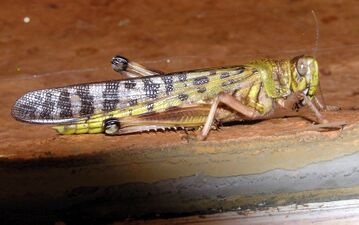
The breeding belts of the desert locust (Schistocerca gregaria) in the "Central Region" stretch across eastern Africa, covering areas from eastern and southern Ethiopia and Somalia, south of the northern coastal escarpment, down to Kenya and northern Tanzania. Summer breeding is limited to northwestern Kenya, the lower, drier and sandier part of the country, along the Rift Valley and near Lake Turkana, and sometimes extends to neighboring areas of Uganda and southeastern Sudan. [2]
There is a high probability for desert locust breeding in the counties of Mandera, Wajir, Marsabit, Garissa, Turkana, and a few sites in Samburu.[3]
Outbreaks
2019-2021
In 2019-2021 Kenya experienced the most severe desert locust invasion in over 70 years. Originating in the Arabian Peninsula, the locusts spread to East Africa, invading 26 counties in Kenya, particularly in the arid and semi-arid northern and northeastern regions. Swarms damaged crops and grazing areas, leading to the loss of around 31,000 hectares of farmland and 580,000 hectares of pastureland. [4] Read more here
During the 2019-2021 desert locust outbreak, control efforts faced several obstacles, including inadequate funding, a lack of appropriate chemicals, and insufficiently trained personnel to use the available chemicals effectively. [4] This is likely due to the long gap since Kenya had last faced an outbreak. See vicious cycle of locust outbreaks.
-

Desert locust swarm in Kenya ©FAO/Sven Torfinn -

Adult desert locusts in Kenya ©FAO/Sven Torfinn -

Desert locust swarm in Kenya ©FAO/Sven Torfinn -

Desert locust outbreak 2020 ©FAO/Sven Torfinn


View the full FAO Flickr photo album of the 2019 desert locust outbreak in Kenya here and here.
Management and research
Kenya is part of the FAO Desert Locust Control Organization for Eastern Africa (DLCO EA). The Kenyan government, through the Ministry of Agriculture and Livestock Development of Kenya, works with partners like the DLCO-EA to management locusts. Farmers use a range of traditional techniques to prevent additional damage, such as striking objects, using twigs or leaves to chase locusts, making noise, lighting fires, trampling, and applying on-farm sprays. [4]
Kenya has many other organizations working in the field of management and research. Notably, the International Centre of Insect Physiology and Ecology (ICIPE) in Nairobi, is a focal center of excellence offering training and a research environment for African scientists from across Africa. Since the 1990s, significant research at ICIPE has focused on locust behavior and ecology, particularly the desert locust. This includes studies on their chemical ecology and the development of biocontrol methods using entomopathogens. [5]
Species gallery
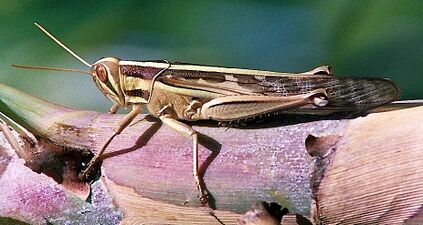
- Highlighted species for Kenya
-

-

-
-

-

-

-

-

-
-

Organizations
Locusts and grasshoppers are typically managed through a national plant protection system led by a country’s plant protection organization, ministry of agriculture, or equivalent biosecurity authority. They are often supported by specialized pest control branches, natural resource agencies, and regional bodies when outbreaks cross borders. These agencies are usually the first point of contact for surveillance, reporting, permits, quarantine decisions, and control operations. If the country belongs to one of the FAO locust commissions, those bodies provide a regional framework for early warning, field surveillance, information sharing, and coordinated response, helping countries align monitoring, contingency planning, and control actions across borders.
Resources
| Name | Species purview | Year published | Resource link | Descriptive keyword | Language | Geographic purview | Author |
|---|---|---|---|---|---|---|---|
| Desert locust field handbook | 2020 | View | Species identification, Management | English | Israel, Democratic Republic of the Congo, Morocco, Algeria, Niger, Mauritania, Chad, Mali, Lebanon, Sudan, Afghanistan, Kuwait, Jordan, United Arab Emirates, Somalia, South Sudan, Pakistan, Ethiopia, Libya, Kenya, India, Oman, Bahrain, Djibouti, Yemen, Uganda, Egypt, Eritrea, Saudi Arabia, Iraq, Palestine, Tanzania, Syria, Iran, Turkey | Centre for Agriculture and Bioscience International | |
| Desert locust invasion responding to a crisis within a crisis | 2020 | View | Presentation, Outbreaks, Emergency response | English | Yemen, Eritrea, Sudan, South Sudan, Djibouti, Somalia, Ethiopia, Kenya, Uganda | ||
| Desert locust surveillance and control programmatic environmental assessment | 2020 | View | Monitoring, Environmental assessment, Management | English | Ethiopia, Kenya, Somalia | United States Agency for International Development | |
| East Africa desert locust crisis fact sheets | 2019, 2020, 2021 | Emergency response, Outbreaks, Series | English | Sudan, South Sudan, Ethiopia, Yemen, Somalia, Kenya, Uganda, Democratic Republic of the Congo | United States Agency for International Development | ||
| East Africa regional desert locust impact monitoring reports | 2021 | Locust outbreaks, Food security, Report, Set | English | Ethiopia, Kenya, Somalia, Uganda | The Food Security and Nutrition Working Group | ||
| Global response plan January–December 2020 | 2020 | View | Emergency response, Outbreaks, Appeal | English | Iran, Yemen, Pakistan, Iraq, India, Ethiopia, Somalia, Kenya, South Sudan, Democratic Republic of the Congo, Tanzania, Uganda | Food and Agriculture Organization of the United Nations | |
| Greater Horn of Africa and Yemen Desert locust crisis appeal | 2020 | View | Appeal, Emergency appeal | English | Djibouti, Ethiopia, Somalia, Sudan, South Sudan, Tanzania, Yemen, Kenya, Uganda, Eritrea | Food and Agriculture Organization of the United Nations | |
| Progress report on the response in the Greater Horn of Africa and Yemen | 2021 | Report, Advisory note, Forecasting, Monitoring, Locust outbreaks, Locusts, Outbreaks, Emergency response, Early warning, Livelihoods, Aerial control operations, Summary, Food security, Chemical control, Biological control, Community development, Collective movement, After action review, Agriculture, Crop health, Economics, Infographic, Advice, Public health, Pesticide management, Progress report, Set | English | Yemen, Somalia, Ethiopia, Kenya | United States Agency for International Development |
Highlighted media coverage
Projects
| Name | Acronym | Image | Status | Project leads | Related organization |
|---|---|---|---|---|---|
| (B)eat the Locust project | Active | International Centre of Insect Physiology and Ecology | |||
| Drones for desert locust control in East Africa | 
|
Active | Centre for Agriculture and Bioscience International | ||
| Project Locust | Active | ||||
| The Bug Picture | 
|
Suspected discontinued effort | Laura Stanford |
References
- ↑ 1.0 1.1 Food and Agriculture Organization of the United Nations (2015) Country Profile - Kenya. https://openknowledge.fao.org/server/api/core/bitstreams/f7c0aebf-73cd-4aa5-b128-13af54b5693b/content
- ↑ Food and Agriculture Organization of the United Nations and Popoc GB (1997) Desert locust atlas. Rome. https://hopperwiki.org/images/e/ec/Atlas_of_desert_locust_breeding_habitats.pdf
- ↑ Kimathi E, Tonnang HEZ, Subramanian S, Cressman K, Abdel-Rahman EM, Tesfayohannes M, Niassy S, Torto B, Dubois T, Tanga CM, Kassie M, Ekesi S, Mwangi D, Kelemu S (2020) Prediction of breeding regions for the desert locust Schistocerca gregaria in East Africa. Scientific Reports 10: 11937. https://doi.org/10.1038/s41598-020-68895-2
- ↑ 4.0 4.1 4.2 Lumumba BO, Otieno DJ, Nyikal RA (2024) Farmers’ perceptions of integrated desert locust management: a case study in Isiolo and Meru Counties of Kenya. Journal of Integrated Pest Management 15: 16. https://doi.org/10.1093/jipm/pmae008
- ↑ Ries MW, Adriaansen C, Aldobai S, Berry K, Bal AB, Catenaccio MC, Cigliano MM, Cullen DA, Deveson T, Diongue A, Foquet B, Hadrich J, Hunter D, Johnson DL, Pablo Karnatz J, Lange CE, Lawton D, Lazar M, Latchininsky AV, Lecoq M, Le Gall M, Lockwood J, Manneh B, Overson R, Peterson BF, Piou C, Poot-Pech MA, Robinson BE, Rogers SM, Song H, Springate S, Therville C, Trumper E, Waters C, Woller DA, Youngblood JP, Zhang L, Cease A (2024) Global perspectives and transdisciplinary opportunities for locust and grasshopper pest management and research. Journal of Orthoptera Research 33(2): 169–216. doi:10.3897/jor.33.112803.