Algeria
| Algeria | |
|---|---|
.svg) | |
| Algeria is within: | |
| Region: | Africa |
| Subregion: | Northern Africa |
Species gallery
- Highlighted species for Algeria
-

-
-

-

-
-

-

-

-

-

-

-

-

-

-

-

Locust breeding grounds
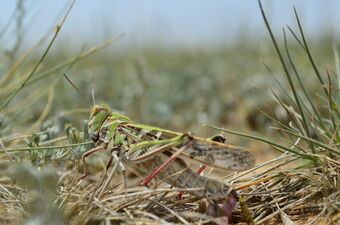
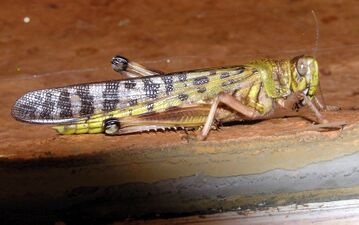
Traditional breeding zones for desert locusts occur in southern Algeria, especially in the Ahaggar Mountains region, and numerous swarms extended north of the Atlas Mountains during both the 1986–1989 plague and the 2003–2005 upsurge.[1][2]
Organizations
Locusts and grasshoppers are typically managed through a national plant protection system led by a country’s plant protection organization, ministry of agriculture, or equivalent biosecurity authority. They are often supported by specialized pest control branches, natural resource agencies, and regional bodies when outbreaks cross borders. These agencies are usually the first point of contact for surveillance, reporting, permits, quarantine decisions, and control operations. If the country belongs to one of the FAO locust commissions, those bodies provide a regional framework for early warning, field surveillance, information sharing, and coordinated response, helping countries align monitoring, contingency planning, and control actions across borders.
Resources
| Name | Species purview | Year published | Resource link | Descriptive keyword | Language | Geographic purview | Author |
|---|---|---|---|---|---|---|---|
| Atlas of desert locust breeding habitats | 1997 | Breeding zones, Habitat, Map, Distribution, Biology, Ecology, Behavior, Phase polyphenism | English | Ethiopia, Senegal, Sudan, Djibouti, Somalia, Algeria, Mauritania, Mali, Egypt, Eritrea, Saudi Arabia, Yemen, Oman, United Arab Emirates | Food and Agriculture Organization of the United Nations, George Basil Popov, G.B. Popov | ||
| Desert locust field handbook | 2020 | View | Species identification, Management | English | Israel, Democratic Republic of the Congo, Morocco, Algeria, Niger, Mauritania, Chad, Mali, Lebanon, Sudan, Afghanistan, Kuwait, Jordan, United Arab Emirates, Somalia, South Sudan, Pakistan, Ethiopia, Libya, Kenya, India, Oman, Bahrain, Djibouti, Yemen, Uganda, Egypt, Eritrea, Saudi Arabia, Iraq, Palestine, Tanzania, Syria, Iran, Turkey | Centre for Agriculture and Bioscience International | |
| Dociostaurus maroccanus Monograph | 2023 | View | Morphology, Distribution, Ecology, Population dynamics, Management, Identification | Russian | Kazakhstan, Kyrgyzstan, Tajikistan, Uzbekistan, Turkmenistan, Algeria, Russia, Georgia (country), Afghanistan, Iraq, Azerbaijan, Italy | FAO Locust Watch in Caucasus and Central Asia, Food and Agriculture Organization of the United Nations | |
| Italian Locust Calliptamus italicus (Linnaeus, 1758) Morphology, Ecology, Distribution, Population Management | 2022 | View | Identification, Distribution, Ecology, Biology, Population dynamics, Behavior, Morphology | Russian | Armenia, Azerbaijan, Georgia (country), Kazakhstan, Kyrgyzstan, Russia, Tajikistan, Turkmenistan, Uzbekistan, Afghanistan, China, Algeria, Italy, Spain, Portugal, France, Belgium, Germany, Greece, Bulgaria, Moldova, Romania, Serbia, Czech Republic, Slovakia, Slovenia, Bosnia and Herzegovina, Hungary, Belarus, Ukraine, Austria, Kosovo, Cyprus, Turkey, Pakistan | Food and Agriculture Organization of the United Nations, Michael Sergeev, Alexandre Latchininsky, M.K. Childebaev, I.A. Vankova, F.A. Gapparov, V.E. Kambulin, E.O. Kokanova, L.B. Pshenitsyna, I.I. Temreshev, M.E. Chernyakhovsky, N.N. Sobolev, V.V. Molodtsov |
Highlighted media coverage
No results found in the database at this time—please reach out if you have any to share!
Projects
No results found in the database at this time—please reach out if you have any to share!
References
- ↑ Showler AT, Lecoq M (2021) Incidence and ramifications of armed conflict in countries with major desert locust breeding areas. Agronomy 11(1): 114. https://doi.org/10.3390/agronomy11010114.
- ↑ Belayneh YT (2005) Acridid pest management in the developing world: a challenge to the rural population, a dilemma to the international community. Journal of Orthoptera Research 14(2): 187–195. https://doi.org/10.1665/1082-6467(2005)14[187:APMITD]2.0.CO;2