Uganda
| Uganda | |
|---|---|
.svg) | |
| Uganda is within: | |
| Region: | Africa |
| Subregion: | Sub-Saharan Africa |
| Intermediate region: | Eastern Africa |

Uganda is a landlocked nation in Eastern Africa, situated on the equator. It shares borders with South Sudan to the north, Kenya to the east, Tanzania and Rwanda to the south, and the Democratic Republic of the Congo to the west. Uganda has a tropical climate that supports its predominantly agricultural economy. [1]
Agriculture in Uganda relies almost entirely on rain-fed farming conducted by small- and medium-scale farmers, with an average national holding size of 1.1 hectares. The limited use of irrigation, along with a lack of modern agricultural practices and inputs such as pesticides, fertilizers, improved crop varieties, and mechanization, contributes to the country's low agricultural productivity and vulnerability to locust outbreaks. [1]
Ecology
The southern part of Uganda includes a substantial portion of Lake Victoria, which it shares with Kenya and Tanzania. Located in the African Great Lakes region, Uganda is also situated within the Nile basin and is the source of the Nile River. The country is divided into two primary agro-ecological systems. The first is the 'tall grass zone,' which is highly productive and located in the south and southwest, within the Lake Victoria crescent. This area benefits from bimodal rainfall and supports perennial cropping. The second system is the 'short-grass zone,' which is more challenging and suited only for growing annual crops. [1]
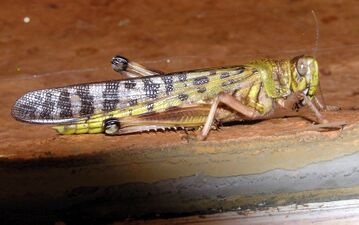
In Uganda, the northern areas are sometimes susceptible to desert locust (Schistocerca gregaria) infestations, especially during the rainy seasons when conditions are ideal for breeding. The eastern regions, particularly near the Kenyan border, often experience locust activity due to their proximity to breeding grounds in Kenya around Lake Turkana. [2]
While the western and central parts of Uganda are less frequently affected, they can still see locust and grasshopper activity during migratory periods or when environmental conditions are favorable. Additionally, the southern regions, including areas around Lake Victoria, may encounter these pests, though they are less common.
Outbreaks
Desert locusts have occasionally impacted Uganda, with outbreaks often originating from neighboring countries like Kenya and spreading into Uganda.
2019-2021
The country was significantly impacted by the recent desert locust outbreak. This outbreak was one of the worst in decades, affecting large swathes of East Africa. The outbreak began in 2019, driven by unusual climatic conditions that favored locust breeding. The situation escalated in 2020-2021, with heavy rains and cyclones creating ideal conditions for the formation of massive locust swarms. These swarms caused extensive damage to crops and pastures, threatening food security and livelihoods. In response, the Food and Agriculture Organization (FAO) of the United Nations, along with regional governments, implemented extensive control measures such as aerial and ground pesticide spraying, monitoring, and early warning systems to combat the infestation and mitigate its impacts. Read more here
Management and research
Uganda is part of the FAO Desert Locust Control Organization for Eastern Africa (DLCO EA) which supports regional control measures and coordinates responses to locust outbreaks across East Africa, including Uganda. In Uganda, the management of locust and grasshopper outbreaks is primarily overseen by the Ministry of Agriculture, Animal Industry and Fisheries (MAAIF), which coordinates pest control efforts and implements surveillance programs. The ministry has a research arm, the National Agricultural Research Organisation that takes on locust related projects. The United Nations Office for the Coordination of Humanitarian Affairs (OCHA) also contributes by coordinating the broader humanitarian response, which includes pest control efforts. These organizations collaborate to monitor, manage, and mitigate the impact of locusts and grasshoppers on Uganda’s agriculture and food security.
Species gallery
- Highlighted species for Uganda
-

-
-

-

-

Organizations
Locusts and grasshoppers are typically managed through a national plant protection system led by a country’s plant protection organization, ministry of agriculture, or equivalent biosecurity authority. They are often supported by specialized pest control branches, natural resource agencies, and regional bodies when outbreaks cross borders. These agencies are usually the first point of contact for surveillance, reporting, permits, quarantine decisions, and control operations. If the country belongs to one of the FAO locust commissions, those bodies provide a regional framework for early warning, field surveillance, information sharing, and coordinated response, helping countries align monitoring, contingency planning, and control actions across borders.
Resources
Highlighted media coverage
| Name | Author | Language | Species purview | Substance | Resource link | Year published |
|---|---|---|---|---|---|---|
| Emergency Locust Response Program Phase 3 The World Bank Group | Intergovernmental Authority on Development | English | Guideline | View | 2021 | |
| New USAID Award to Combat Desert Locusts | English | News article | 2020 | |||
| Nsenene kept away this time now we need to rear our own | English | News article | 2023 | |||
| Nsenene return leaves bittersweet taste in Fort Portal Bundibugyo | English | News article | 2023 | |||
| The vitality and fragility of trapping grasshoppers | English | News article | 2022 | |||
| The World Bank Group and the Locust Crisis | English | News article | 2020 | |||
| World Bank Announces $500 Million to Fight Locusts | English | News article | 2020 |
Projects
No results found in the database at this time—please reach out if you have any to share!
References
- ↑ 1.0 1.1 1.2 Food and Agriculture Organization of the United Nations (2014) Country Profile - Uganda. https://openknowledge.fao.org/server/api/core/bitstreams/57904a11-9bd2-41a4-9866-50d6a5a3dde7/content
- ↑ Food and Agriculture Organization of the United Nations and Popoc GB (1997) Desert locust atlas. Rome. https://hopperwiki.org/images/e/ec/Atlas_of_desert_locust_breeding_habitats.pdf