South Sudan
| South Sudan | |
|---|---|
.svg) | |
| South Sudan is within: | |
| Region: | Africa |
| Subregion: | Sub-Saharan Africa |
| Intermediate region: | Eastern Africa |

South Sudan, located in East-Central Africa, is the world's youngest nation, having gained its independence from Sudan in 2011 following a civil war. This landlocked nation shares borders with Sudan to the north, Ethiopia and Kenya to the east, Uganda and the Democratic Republic of Congo to the south, and the Central African Republic to the west. [1]
Agriculture in South Sudan is primarily rain-fed small-scale subsistence farming, with crops grown by hand on household plots of less than two hectares. [1] The livestock population in South Sudan includes cattle, sheep, and goats, primarily raised in the arid and semi-arid regions like Eastern Equatoria. Livestock are typically raised in nomadic pastoralist or mixed crop-livestock systems, serving as a crucial source of livelihoods, particularly in the Upper Nile floodplains and semi-arid pastoral areas. [1]
South Sudan faces significant challenges, including political instability, ongoing conflict, and economic difficulties. More than 500,000 people fleeing the Sudan conflict crossed into South Sudan in 2023. The increasing shocks have left smallholder farmers in many regions unable to produce sufficient food. Furthermore, due to a heavy dependence on imports, many people in South Sudan cannot afford essential food items and are forced to depend on humanitarian aid. [2]
Ecology
The nation's landscape is dominated by vast wetlands, savannahs, and the Nile River, which plays a crucial role in its agriculture and transportation. The most prominent geographical feature of the country is the White Nile River, which flows across clay plains and gradually ascends southward to mountains reaching up to 3,000 meters in elevation in the Imatong Hills. The Sudd wetland, one of the largest swamps in the world, forms the inland delta of the White Nile. The cultivable area is estimated at approximately 2.76 million hectares, which represents 4 percent of the total land area. Nearly half of this arable land is located in the Upper Nile, Jonglei, and Warrap states. Additionally, shrubs cover around 39 percent of the country, while herbaceous vegetation accounts for about 22 percent. [1]
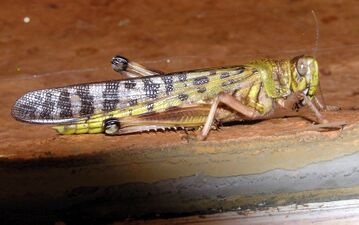
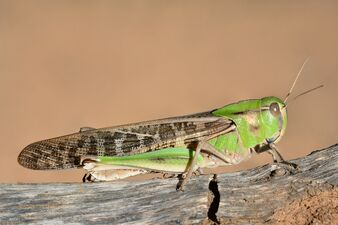
South Sudan is at risk of desert locust (Schistocerca gregaria) breeding in the northern regions and the south east corner bordering Kenya. These sites exist in northern Bahr el Ghazal, Unity, Upper Nile, Eastern Equatoria, Warrap, Lakes, and some parts of Jonglei state. [3]
Outbreaks
2019-2021
The country was significantly impacted by the recent desert locust outbreak. This outbreak was one of the worst in decades, affecting large swathes of East Africa. The outbreak began in 2019, driven by unusual climatic conditions that favored locust breeding. The situation escalated in 2020-2021, with heavy rains and cyclones creating ideal conditions for the formation of massive locust swarms. These swarms caused extensive damage to crops and pastures, threatening food security and livelihoods. In response, the Food and Agriculture Organization (FAO) of the United Nations, along with regional governments, implemented extensive control measures such as aerial and ground pesticide spraying, monitoring, and early warning systems to combat the infestation and mitigate its impacts. Read more here
South Sudan faced multiple waves of desert locust infestations that spread from Northern Kenya. The most affected areas were Magwi, Kapoeta, Torit, and Ikotos Counties in Eastern Equatoria State. [4]
Management and research
South Sudan is part of the FAO Desert Locust Control Organization for Eastern Africa (DLCO EA). The management of locusts and grasshoppers is primarily handled by the Ministry of Agriculture and Food Security in partnership with international organizations.The DLCO EA assists with regional coordination and control measures, including aerial spraying. The United Nations Office for the Coordination of Humanitarian Affairs (OCHA) helps coordinate the broader humanitarian response. These efforts aim to mitigate the impact of locusts and grasshoppers on agriculture and food security, despite challenges posed by ongoing conflict and limited resources.
Species gallery
- Highlighted species for South Sudan
-
-

-
-

Organizations
Locusts and grasshoppers are typically managed through a national plant protection system led by a country’s plant protection organization, ministry of agriculture, or equivalent biosecurity authority. They are often supported by specialized pest control branches, natural resource agencies, and regional bodies when outbreaks cross borders. These agencies are usually the first point of contact for surveillance, reporting, permits, quarantine decisions, and control operations. If the country belongs to one of the FAO locust commissions, those bodies provide a regional framework for early warning, field surveillance, information sharing, and coordinated response, helping countries align monitoring, contingency planning, and control actions across borders.
Resources
Highlighted media coverage
| Name | Author | Language | Species purview | Substance | Resource link | Year published |
|---|---|---|---|---|---|---|
| Emergency Locust Response Program Phase 3 The World Bank Group | Intergovernmental Authority on Development | English | Guideline | View | 2021 | |
| The double burden of COVID-19 and locusts in East Africa | International Rescue Committee | English | News article | View |
Projects
No results found in the database at this time—please reach out if you have any to share!
References
- ↑ 1.0 1.1 1.2 1.3 Food and Agriculture Organization of the United Nations (2015) Country Profile - South Sudan. https://openknowledge.fao.org/server/api/core/bitstreams/57904a11-9bd2-41a4-9866-50d6a5a3dde7/content
- ↑ World Food Programme USA (WFP USA) (n.d.) South Sudan. WFP USA. Retrieved September 11, 2024, from https://www.wfp.org/countries/south-sudan
- ↑ Kimathi E, Tonnang HEZ, Subramanian S, Cressman K, Abdel-Rahman EM, Tesfayohannes M, Niassy S, Torto B, Dubois T, Tanga CM, Kassie M, Ekesi S, Mwangi D, Kelemu S (2020) Prediction of breeding regions for the desert locust Schistocerca gregaria in East Africa. Scientific Reports 10: 11937. https://doi.org/10.1038/s41598-020-68895-2
- ↑ Mario Y (2022) Assessing the Impact of Desert Locust Infestation on Crops, Pasture and Livestock Health in Eastern Equatoria State, South Sudan. Yuga ME. Available from: https://www.academia.edu/80448779/Assessing_the_Impact_of_Desert_Locust_Infestation_on_Crops_Pasture_and_Livestock_Health_in_Eastern_Equatoria_State_South_Sudan (September 11, 2024).