Argentina
| Argentina | |
|---|---|
.svg) | |
| Argentina is within: | |
| Region: | Americas |
| Subregion: | Latin America and the Caribbean |
| Intermediate region: | South America |
Situation overview
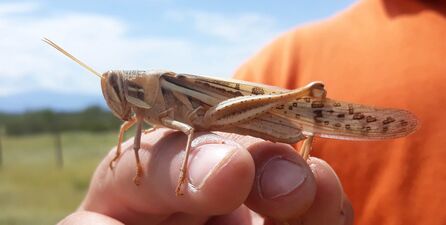
South American locust, Schistocerca cancellata (Serville, 1838)
Species gallery
- Highlighted species for Argentina
-

-

-

-

-

-

-

-
-

-

-

-

-

Organizational relationships
In Argentina, the challenge posed by S. cancellata is addressed through a network of collaborating stakeholders, which encompass both public and private entities.[1] The planning process follows a hierarchical structure, spanning from national to provincial and municipal organizations. The pivotal responsibility of coordinating and executing monitoring and control initiatives, as well as sustaining an ongoing surveillance program in breeding zones, falls under the jurisdiction of the National Food Safety and Quality Service (SENASA). This is accomplished through its Locusts & Grasshoppers National Programs (L&GNP).
The task of locust control is entrusted to SENASA by the National Ministry of Agriculture, Livestock and Fisheries (MAGyP), with an operational budget being allocated by SENASA to the L&GNP.[1] During outbreaks, the responsibility for implementation is divided between different levels of public administration, from provincial down to municipal levels, and among private stakeholders, from national to provincial and sub-provincial tiers. In these situations, the L&GNP collaborates with agronomy schools by involving them in crisis committees. These committees serve as platforms for delivering instructions, regulations, training, and essential information.
Financial resources from SENASA to farmers are often channeled indirectly, occasionally through direct control measures. The primary duty for managing pests on private land rests with individual landowners or lessees.[1] Provincial and municipal administrations contribute by offering support staff and/or essential resources such as pesticides and fuel, and they may also engage in contracting aerial application services.
Decisions regarding the engagement of academic, scientific, or public technology institutions for the development of management solutions are influenced by both self-initiated efforts from the scientific community and situational requests from SENASA and/or the National Agricultural Technology Institute (INTA).[1]
Organizations
Locusts and grasshoppers are typically managed through a national plant protection system led by a country’s plant protection organization, ministry of agriculture, or equivalent biosecurity authority. They are often supported by specialized pest control branches, natural resource agencies, and regional bodies when outbreaks cross borders. These agencies are usually the first point of contact for surveillance, reporting, permits, quarantine decisions, and control operations. If the country belongs to one of the FAO locust commissions, those bodies provide a regional framework for early warning, field surveillance, information sharing, and coordinated response, helping countries align monitoring, contingency planning, and control actions across borders.
Resources
| Name | Species purview | Year published | Resource link | Descriptive keyword | Language | Geographic purview | Author |
|---|---|---|---|---|---|---|---|
| Acridomorph species of Argentina and Uruguay | Management, Biology, Species identification | English | Argentina, Uruguay | National University of La Plata | |||
| Alertas Senasa App | App, Emergency alerts | Spanish | Argentina | The National Food Safety and Quality Service | |||
| Control recommendations for locust and grasshoppers in Argentina | 2020 | View | Management, Training manual | Spanish | Argentina | Chamber of Agricultural Health and Fertilizers, The National Food Safety and Quality Service | |
| GICSV 2020 International Year of the Plant Health technical reports | 2021 | Biology, Distribution, Population dynamics, Set | English | Argentina, Paraguay, Uruguay, Chile, Bolivia, Brazil | Inter-American Coordinating Group in Plant Protection | ||
| Regional alert system for the South American locust | 2023 | Emergency alerts, Early warning | Spanish | Argentina | Comité de Sanidad Vegetal del Cono Sur, National Agricultural Technology Institute, Inter-American Institute for Cooperation on Agriculture | ||
| Seminario de Cooperación Regional Langosta Sudamericana: Estado de situación y cooperación | 2020 | View | Video, Regional cooperation, Outbreaks, Report | Spanish | Argentina, Bolivia, Uruguay, Brazil, Paraguay | The National Food Safety and Quality Service | |
| SENASA locust bulletin | Emergency alerts | Spanish | Argentina | The National Food Safety and Quality Service | |||
| Situation of locust and grasshopper plagues in South America December 2022 | 2022 | View | Spanish | Argentina, Bolivia, Brazil, Chile, Paraguay, Peru, Uruguay | Comité de Sanidad Vegetal del Cono Sur, The National Food Safety and Quality Service, Servicio Nacional de Sanidad Agropecuaria e Inocuidad Alimentaria, National Plant and Seed Health and Quality Service, Servivio Nacional de Sanidad Agraria, National Ministry of Agriculture, Livestock and Fishery | ||
| South American Acridia management dashboard | 2023 | View | Management, Communication resource | Spanish | Argentina, Paraguay, Uruguay, Bolivia | The National Food Safety and Quality Service | |
| South American locust control manual | 2018 | View | Management, Training manual | Spanish | Argentina | The National Food Safety and Quality Service | |
| South American locust NSF Grant for Rapid Response Research project summary | 2021 | Summary, Set, Project, Project report | English, Spanish, French | Argentina, Uruguay, Paraguay, Bolivia, United States | The National Food Safety and Quality Service, Servicio Nacional de Sanidad Agropecuaria e Inocuidad Alimentaria, National Plant and Seed Health and Quality Service, Global Locust Initiative, Universidad Autónoma Gabriel René Moreno, Arizona State University | ||
| South American locust WhatsApp Alert Channel | 2023 | Communication resource, Artificial intelligence, Emergency alerts | Spanish | Argentina | The National Food Safety and Quality Service | ||
| Synthesis of the governance workshop on the South American Locust | 2021 | Workshop, Summary, Governance, Set, Meeting, Project report | English, Spanish | Argentina, Bolivia, Paraguay, Uruguay, United States | Foundation for Food & Agriculture Research, The National Food Safety and Quality Service, Global Locust Initiative, Clara Therville, John Anderies, Hector Medina, Rick Overson, Eduardo Trumper, Arianne Cease |
Highlighted media coverage
Projects
References
- ↑ 1.0 1.1 1.2 1.3 Ries MW, Adriaansen C, Aldobai S, Berry K, Bal AB, Catenaccio MC, Cigliano MM, Cullen DA, Deveson T, Diongue A, Foquet B, Hadrich J, Hunter D, Johnson DL, Pablo Karnatz J, Lange CE, Lawton D, Lazar M, Latchininsky AV, Lecoq M, Le Gall M, Lockwood J, Manneh B, Overson R, Peterson BF, Piou C, Poot-Pech MA, Robinson BE, Rogers SM, Song H, Springate S, Therville C, Trumper E, Waters C, Woller DA, Youngblood JP, Zhang L, Cease A (2024) Global perspectives and transdisciplinary opportunities for locust and grasshopper pest management and research. Journal of Orthoptera Research 33(2): 169–216. doi:10.3897/jor.33.112803.