Kiowa grasshopper (Trachyrhachys kiowa)
| Trachyrhachys kiowa | |
|---|---|
 | |
| Other common names | |
| Ash-brown grasshopper | |
| Taxonomic classification | |
| Suborder: | Caelifera |
| Family: | Acrididae |
| Subfamily: | Oedipodinae |
| Tribe: | Psinidiini |
| Genus: | Trachyrhachys |
| Scientific name | |
| Trachyrhachys kiowa (Thomas, 1872) | |
| Geography | |
| Native countries: | |
| Pest status | |
| Known pest | |
The Kiowa grasshopper (Trachyrhachys kiowa), also commonly known as the ash-brown grasshopper, [1] is a medium sized rangeland species found throughout North America most commonly in the west. This species is part of a subfamily of band-winged grasshoppers and is sometimes abundant enough to cause damage to rangelands.
Taxonomy
For full nomenclature and taxonomic details of this taxon, see Orthoptera Species File
Identification
The Kiowa grasshopper is a species of band-winged grasshoppers (subfamily Oedipodinae, family Acrididae), which are a distinctive feature of the semi-arid grasslands of North America. Anatomically, they are easily recognized by their large, lobed hindwings, often marked with spots or bands—features that set them apart from other grasshopper subfamilies. These hindwings also play a role in their behavior; many species produce a loud snapping crepitation during flight, which can be heard from across a pasture or field, making them identifiable even to those unfamiliar with insect taxonomy.[2]
The band-winged grasshoppers form a distinct yet highly diverse group. While most species are harmless and should not be targets of control, the group also includes some of the most destructive pest species, like the clear-winged grasshopper. It ranges from delicate, inconspicuous grasshoppers to the largest and most visually striking ones in North America. [2]
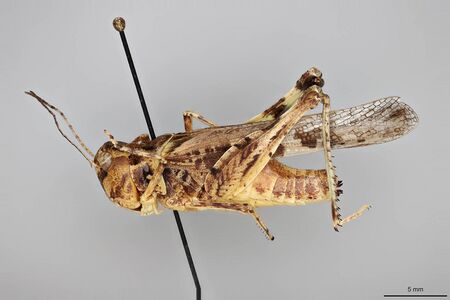
The Kiowa grasshopper is usually gray-brown, yellow-green, or tan with large spots or bands on its front wings. It has a raised ridge on its back with two notches and a stripe along the edge. Its head is relatively big with dark stripes under the eyes, and it has thin antennae and long wings. The back wings are often pale yellow with a broken black band, but in the north, they may be clear. Its back legs have long hairs, two pale yellow bands, and a dark inner area. The lower legs are blue or gray with tan areas and brown spots.
Nymphs are tan with dark markings or pale green with fewer marks. They have a straight face, a dark stripe on the head, and hairs on the back legs.
The Kiowa grasshopper resembles the finned grasshopper (Trachyrhachys aspera) and can be distinguished by the posterior angle of the lateral lobes of the pronotum. T. Kiowa has a posterior angle that is acute where T. aspera is at an almost right angle. [3]
Identification details
The Kiowa grasshopper is generally grayish-brown, greenish-yellow, pale green, or tan, with large spots or bands on the forewings. The pronotum has an elevated ridge with two notches. [3] A tan or gray stripe typically lines the posterior edge of the pronotum, though it appears green in a few rare individuals.[4] The face is large and usually marked with dark stripes under the eye. Antennae are slender and forewings are long.[3] Two or three large dark brown marks can be found in the middle of the tegmen, these markings get more abundant near the end.[5] Hindwings are variable colors, often pale yellow with an incomplete black band [3]. It is also reported that their hindwings contain no color in northern regions and usually lack markings.[5]
There is a fringe of long hairs on the lower carina on the hind femur. The hind femur also contains two pale yellow bands, found near the knee and in the center of the femur. The inner medial area is generally dark brown or gray. Their hind tibia is blue or gray [3], with the inner side being the most distinctly blue, with the proximal end being more tan. This tan proximal area usually contains brown spots or markings.[5]
Kiowa grasshopper nymphs are typically tan with dark brown markings, though some pale green ones have fewer but more distinct markings. They can be identified by their nearly vertical face and a thin dark stripe across the top of the head, between the eyes. Notably, they have fringe hairs on their hind femur, most visible in the 3rd and 4th instar stages.[5]
Featured identification resources


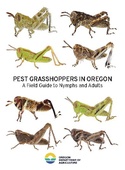
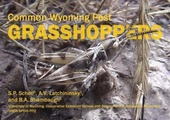
All identification resources
| Title | Author(s) | Year | Geographic purview | URL |
|---|---|---|---|---|
| Common Grasshoppers of Montana Cropland and Rangeland | Montana State University | View URL | ||
| A Manual of the Grasshoppers of New Mexico | New Mexico Cooperative Extension Service,D.B. Richman, D.C. Lightfoot, C.A. Sutherland and DJ. Ferguson | 1993 | View URL | |
| Grasshopper investigations on Montana rangelands | Montana State University,Norman L. Anderson and John C. Wright | 1952 | View URL | |
| Orthoptera of Northern Great Plains | North Dakota State University | 2007 | ||
| Hopper helper | Wendal Cushing | View URL | ||
| The grasshoppers of Nebraska | Animal and Plant Health Inspection Service,Mathew L. Brust, Wyatt Hoback and Robert J. Wright | 2009 | View URL | |
| Common Wyoming pest grasshoppers | University of Wyoming,Scott Schell and Alexandre Latchininsky,B.A. Shambaugh | View URL | ||
| Field guide to some of the common grasshoppers of the Front Range of Colorado | University of Colorado | View URL | ||
| Montana.gov Orthoptera Field Guides | View URL | |||
| Field Guide to Common Western Grasshoppers | United States Department of Agriculture,Robert E. Pfadt | 2002 | ||
| Grasshoppers of the Western United States | United States Department of Agriculture | View URL | ||
| ARS grasshopper species fact sheets | Agricultural Research Services and United States Department of Agriculture | 1994 | ||
| Pest Grasshoppers of the West | University of Wyoming | 2005 | View URL | |
| The Grasshoppers of the Western U.S. Lucid mobile app | APHIS PPQ Science & Technology Insect Management and Molecular Diagnostics Laboratory (Phoenix Station), United States Department of Agriculture and Center for Plant Health Science and Technology of the USDA | 2016 | ||
| Rangeland Grasshopper Management | University of Wyoming,Jeffrey Lockwood and Scott Schell | 1993 |
Distribution
The Kiowa grasshopper is abundant throughout the United States, less so in southern and New England states. This species is also found in southwestern Canada and throughout Mexico. [3]
Biology
The kiowa grasshopper has one generation per year.[5] Hatching begins around mid June, lasting two to four weeks. The nymph period lasts around 27 to 53 days, with development requiring 5 instars.[6] Adults are found from June to November. [3] Male Kiowa grasshoppers court females on the ground using single stridulating strokes of their hind legs and tap the female's head with their antennae before mounting. Females lay 8–10 eggs in bare soil near vegetation. The eggs are brown ors tan and pods contains eight to ten eggs, with dimensions around 4.4 to 5 mm in length.[5] Eggs start developing in the summer when they are laid and continue growing until they enter diapause. Around spring, development resumes until the embryos fully mature and hatch.[6]
Kiowa grasshoppers rest flat on the ground at night, even in cool temperatures. After sunrise, they start basking by turning their bodies to face the sun and exposing their abdomen to warm up. If it gets too hot (around 130°F), they move into plants or shade to cool off. When it cools down again, they return to basking until sunset.[5] Generally, these grasshoppers spend 37% of their time basking, 31% pottering, and 32% feeding.[6]
Photos of this species
-
Trachyrhachys kiowa -

Trachyrhachys kiowa -

Trachyrhachys kiowa


Habitat and ecology
T. kiowa lives in mixedgrass, shortgrass, and desert prairies, and is typically found in barren or sparsely vegetated microhabitats, often near low grass clumps.[7][3] It frequently occurs in gravel pits, roadsides, rocky slopes, and open, sandy upland fields with patchy grass.[1] It is also considered a pest in crested wheatgrass pastures.[6] Its gray or tan coloring allows it to camouflage well against pale soils.[8] T. kiowa eats almost exclusively grasses, with a strong preference for blue grama (Bouteloua gracilis), a key host plant in shortgrass and mixedgrass prairies.[5][9] Other food plants include needleandthread, western wheatgrass, Kentucky bluegrass, threadleaf sedge, needle-leaf sedge, Penn sedge,[5] sunsedge,[6] sixweeks fescue, and sand dropseed.[9] Nymphs don’t eat plant litter, and adults rarely do. They feed from the tip of a plant downward. On grasses like blue grama, they may feed on lower green leaves or pull higher leaves toward themselves using their front legs, while supporting themselves with their middle and hind legs.[5] In tallgrass prairies, they move to areas with shorter, sparser grass such as hilltops or disturbed ground. Adults may also feed on small lichens that grow in mats on the soil surface.[5] T. kiowa is a strong flier.[7] When disturbed, it makes short, dodging flights with soft crepitation sounds. It may fly in straight or curved paths and often lands sideways, facing away from the threat.[5]
Land-use change
Pest status
T. kiowa presents an occasional threat to grasslands in the western US states.[1] In mixed grass prairies, Kiowa grasshopper populations usually stay low. However, under the right conditions, their numbers can suddenly surge, tripling or even increasing sevenfold in a year, especially when other grasshopper species like the bigheaded and white whiskered grasshoppers are also abundant. [5] For this reason, it is one of the top dozen species monitored by USDA Animal and Plant Health Inspection Service (APHIS) because of its impact on rangelands.
Management
The main strategy for managing grasshopper outbreaks on rangelands in the United States involves the use of insecticides applied via all-terrain vehicle (ATV)-mounted or aerial sprayers. Recommended insecticides include diflubenzuron, malathion, chlorantraniliprole, various pyrethroids, and carbaryl. Applications are made either through full-area coverage or using a method known as Reduced Agent and Area Treatments (RAATs). RAATs are an integrated pest management (IPM) technique where insecticide rates are lowered from standard levels, and treated swaths are alternated with untreated ones, reducing total coverage to 50% or less. This method combines direct chemical control (killing grasshoppers in treated areas and as they migrate from untreated zones) with conservation biological control, allowing natural enemies in untreated areas to help suppress the population. This IPM strategy can cut both insecticide use and treatment costs by more than half. Control efforts typically achieve around 80% effectiveness, which is adequate to suppress most grasshopper populations. The insect growth regulator diflubenzuron has shown particular success in RAAT applications due to its long-lasting residual toxicity, which persists for about three weeks.[10][11][12]
Outbreaks
Outbreak media coverage
Associated organizations
No results found in the database at this time—please reach out if you have any to share!
Resources
| Title | Author(s) | Year | Geographic purview | URL |
|---|---|---|---|---|
| Common Grasshoppers of Montana Cropland and Rangeland | Montana State University | View URL | ||
| A Manual of the Grasshoppers of New Mexico | New Mexico Cooperative Extension Service,D.B. Richman, D.C. Lightfoot, C.A. Sutherland and DJ. Ferguson | 1993 | View URL | |
| Grasshopper investigations on Montana rangelands | Montana State University,Norman L. Anderson and John C. Wright | 1952 | View URL | |
| Orthoptera of Northern Great Plains | North Dakota State University | 2007 | ||
| Hopper helper | Wendal Cushing | View URL | ||
| The grasshoppers of Nebraska | Animal and Plant Health Inspection Service,Mathew L. Brust, Wyatt Hoback and Robert J. Wright | 2009 | View URL | |
| Common Wyoming pest grasshoppers | University of Wyoming,Scott Schell and Alexandre Latchininsky,B.A. Shambaugh | View URL | ||
| Field guide to some of the common grasshoppers of the Front Range of Colorado | University of Colorado | View URL | ||
| Montana.gov Orthoptera Field Guides | View URL | |||
| Field Guide to Common Western Grasshoppers | United States Department of Agriculture,Robert E. Pfadt | 2002 | ||
| Grasshoppers of the Western United States | United States Department of Agriculture | View URL | ||
| ARS grasshopper species fact sheets | Agricultural Research Services and United States Department of Agriculture | 1994 | ||
| Pest Grasshoppers of the West | University of Wyoming | 2005 | View URL | |
| The Grasshoppers of the Western U.S. Lucid mobile app | APHIS PPQ Science & Technology Insect Management and Molecular Diagnostics Laboratory (Phoenix Station), United States Department of Agriculture and Center for Plant Health Science and Technology of the USDA | 2016 | ||
| Rangeland Grasshopper Management | University of Wyoming,Jeffrey Lockwood and Scott Schell | 1993 |
Specimen contributors for this species
 Bionomia links specimen records in GBIF to the people who collected and identified them. Each list shows the top 20 for this species. Read more…
Collected by
People who collected specimens of this species in the field.
- Charles Hart — 3 specimens collected
- Shigetsura Shiga — 2 specimens collected
- Theodore Henry Frison — 1 specimen collected
- Barnard Burks — 1 specimen collected
- Selim Peabody — 1 specimen collected
- Carlos Gerardo Velazco-Macías — 1 specimen collected
- Austin Kelly — 1 specimen collected
Identified by
People who determined the taxonomic identity of specimens of this species.
- Tyler Grant — 25 specimens identified
References
- ↑ 1.0 1.1 1.2 Bland GR (2003) The Orthoptera of Michigan: Biology, Keys, and Descriptions of Grasshoppers, Katydids, and Crickets. Michigan State University Extension Bulletin E-2815, 220 pp. https://archive.lib.msu.edu/DMC/Ag.%20Ext.%202007-Chelsie/PDF/e2815.pdf
- ↑ 2.0 2.1 Johnson DL (n.d.) Band-winged grasshoppers of the Canadian Prairies and Northern Great Plains. Environmental Health, Agriculture and Agri‑Food Canada Research Centre, Lethbridge, AB & University of Lethbridge, Lethbridge, AB, Canada. https://hopperwiki.org/images/0/0d/Band-winged_grasshoppers_of_the_Canadian_Prairies_and_Northern_Great_Plains.pdf
- ↑ 3.0 3.1 3.2 3.3 3.4 3.5 3.6 3.7 Capinera JL, Scott RD, Walker TJ (2005) Field guide to grasshoppers, katydids, and crickets of the United States. Cornell University Press, Ithaca, New York, 280 pp.
- ↑ Hill JG (2012) Habitat associations of grasshoppers (Orthoptera: Acrididae) in the heterogeneous cedar glade landscape of the Central Basin of Tennessee. Journal of Orthoptera Research 21: 227–233. https://doi.org/10.1665/034.021.0207
- ↑ 5.00 5.01 5.02 5.03 5.04 5.05 5.06 5.07 5.08 5.09 5.10 5.11 5.12 Pfadt RE (1994) Kiowa Grasshopper Trachyrhachys kiowa (Thomas). Wyoming Agricultural Experiment Station Bulletin 912. Species Fact Sheet. https://www.ars.usda.gov/ARSUserFiles/30320505/grasshopper/Extras/PDFs/Species%20Fact%20Sheets/Kiowa.pdf
- ↑ 6.0 6.1 6.2 6.3 6.4 Proactive management of pestiferous rangeland grasshopper habitat of the Northern Plains. North Dakota State University Dickinson Research Extension Center, Rangeland Research Outreach Program DREC 14-4021: 1–44. https://www.ndsu.edu/agriculture/sites/default/files/2022-10/grassland14h.pdf
- ↑ 7.0 7.1 Joern A (1983) Small-scale displacements of grasshoppers (Orthoptera: Acrididae) within arid grasslands. Journal of the Kansas Entomological Society 56: 131–139.
- ↑ Hill JG (2007) The grasshopper (Orthoptera: Romaleidae: Acrididae) fauna of Black Belt Prairie remnants in Alabama and Mississippi. Journal of Orthoptera Research 16: 139–144. https://www.mississippientomologicalmuseum.org.msstate.edu/museumpersonnel./JoVonn%27s.pdf.files/Black%20Belt%20Hoppers.pdf
- ↑ 9.0 9.1 Hansen RM, Ueckert DN (1971) Dietary overlap of grasshoppers on sandhill rangeland in northeastern Colorado. Oecologia 8: 276–295. https://www.jstor.org/stable/4214718
- ↑ Latchininsky A (2019) In: Lecoq M, Zhang L (Eds) Encyclopedia of pest Orthoptera of the world. China Agricultural University Press, Beijing, China, pp. 9, 23, 53, 136, 141, 145, 151.
- ↑ Latchininsky AV, Schell SP (2007) Aerial RAATs brochure. ATV-RAATs brochure. UW CES Bulletin MP-95, Laramie, WY, USA.https://hopperwiki.org/index.php/UWYO_information_on_reduced_agent_and_area_treatments_(RAATs)
- ↑ Lockwood JA, Schell SP (1997) Decreasing economic and environmental costs through reduced area and agent insecticide treatments (RAATs) for the control of rangeland grasshoppers: empirical results and their implications for pest management. Journal of Orthoptera Research 6: 19–32.